野
Character Story & Explanation
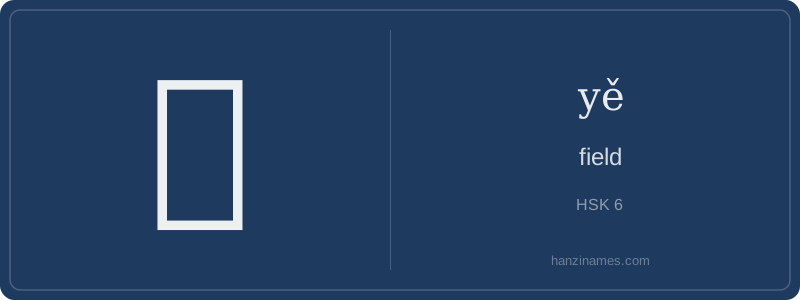
In modern Chinese, 野 most commonly appears in compound words denoting natural, non-urban, or untamed contexts—especially in ecology, agriculture, and lifestyle language. It’s central to HSK 6 vocabulary like 野外 (yěwài, 'outdoors/field'), 野心 (yěxīn, 'ambition'—lit. 'wild heart'), and 野史 (yěshǐ, 'unofficial history'). The idiom 放虎归山,纵野入林 (fàng hǔ guī shān, zòng yě rù lín) reflects its enduring association with unrestrained force. Documented usage dates to Bronze Age inscriptions, where 野 consistently marked territorial peripheries.
The character’s form combines the radical 里 (originally a pictograph of dwelling units, later standardized as 'village') with 予 (yǔ, 'to give'), though phonetic borrowing dominates here—予 serves mainly as a sound hint for yě. No oracle-bone pictograph of ‘field’ survives for 野; instead, early forms show 里 + 夂 (zhǐ, 'to go'), emphasizing movement outward—into the open, unbounded land.
Picture a misty autumn morning in Yunnan’s Yuanyang rice terraces—water-filled paddies shimmer like shattered mirrors under pale sun, stretching across hillsides far beyond the village. This vast, untamed expanse is precisely what 野 (yě) evokes: not just cultivated land, but open, unconfined space—the field beyond boundaries, where nature asserts itself freely. The character carries connotations of wildness, spontaneity, and freedom from human control.
Historically, 野 distinguished rural, uncultivated land from the walled ‘city’ (城, chéng) and administrative centers. In ancient texts like the *Zuo Zhuan*, 野 referred to territories outside urban jurisdiction—places of farmers, hunters, and outcasts. It implied both physical distance and social marginality, yet also authenticity and raw vitality absent in courtly life.
Today, 野 retains layered resonance: it appears in ecological discourse (e.g., 野外调查, yěwài diàochá, 'field survey'), culinary culture (野菜, yěcài, 'wild vegetables'), and even personality descriptors (野性, yěxìng, 'wild spirit'). Its radical 里 (lǐ, 'village unit') ironically anchors this 'wild' concept—not as opposition to civilization, but as its essential, breathing counterpart: the field that feeds, inspires, and humbles.
Example Sentences
Common Compounds
Similar Characters — Don't Mix These Up
Your First Step into Chinese Culture: Get a Chinese Name
Every journey into Chinese begins with a name. Use our free Chinese name generator to create a meaningful, personalized Chinese name that fits you perfectly.
Get My Chinese Name →