坛
Character Story & Explanation
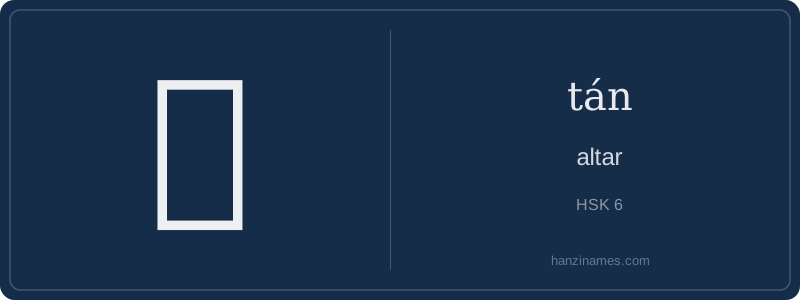
Historically, 坛 appears in official records like the Book of Rites (Liji) describing state altars for Heaven, Earth, and Grain. Today, it’s most commonly seen in compound nouns: 文坛 (wéntán, 'literary circle'), 酒坛 (jiǔtán, colloquial for 'wine community' or 'jar'), and in place names like 天坛 (Tiāntán, Temple of Heaven). The idiom '一坛老酒' ('a jar of aged wine') reflects its enduring association with ceremonial vessels and communal veneration.
The character is not pictographic in oracle bone script—it evolved during the Warring States period from seal script. Its form combines 土 (earth/soil, the foundational radical) and 又 (originally a hand, later phonetic), with no verified ancient pictorial representation of an altar. In daily life, Chinese speakers encounter it most often on wine labels, cultural news headlines, or historical site signage.
As an archaeologist brushing dust from a Han dynasty ritual tablet, I find 坛 not as a static symbol but as layered strata of sacred space—earth (土) raised deliberately to meet heaven. Its seven strokes encode intentionality: the radical 土 grounds it in soil and sovereignty, while the 又 component (originally a hand or action marker) signals human consecration. This isn’t just ‘altar’ as furniture—it’s a verb-noun hybrid: the act *and* the site of elevation.
Excavations at the Temple of Heaven in Beijing reveal how 坛 shaped imperial cosmology: the Circular Mound Altar (圜丘坛) wasn’t merely stone—it was calibrated geometry made terrestrial, where emperors performed winter solstice sacrifices to Shangdi. Each tier’s number (3, 5, 7, 9) echoed cosmic numerology, turning the character into architectural theology carved in marble and meaning.
Modern usage preserves this duality: a ‘literary forum’ (文坛) or ‘wine坛’ (wine坛, colloquial for ‘wine circle’) repurposes the altar’s essence—not for gods, but for shared reverence. The character’s endurance lies in its semantic elasticity: wherever people gather with ritual gravity—be it poetry, politics, or premium baijiu—the altar re-emerges, unbroken across 2,000 years.
Example Sentences
Common Compounds
Similar Characters — Don't Mix These Up
Your First Step into Chinese Culture: Get a Chinese Name
Every journey into Chinese begins with a name. Use our free Chinese name generator to create a meaningful, personalized Chinese name that fits you perfectly.
Get My Chinese Name →