垄
Character Story & Explanation
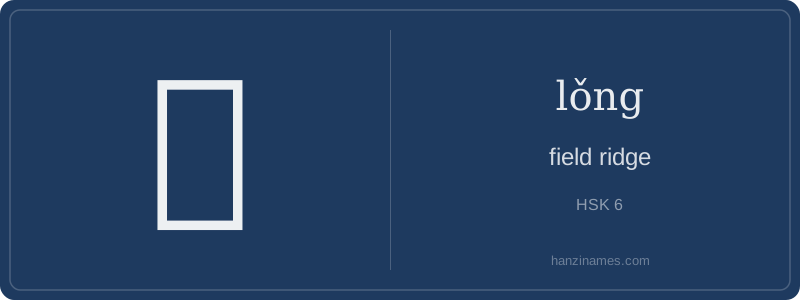
In contemporary rural China, 垄 is used daily by farmers, agricultural extension workers, and in government documents on land management. It appears in standardized phrases like ‘起垄栽培’ (qǐ lǒng zāipéi, ridge-based cultivation), a key technique promoted nationwide for drought-prone crops. The term also features in historical land surveys—e.g., Ming Dynasty tax records referenced ‘田垄’ (tián lǒng) to denote taxable field boundaries. Modern usage remains strictly agricultural; no common idioms contain 垄 alone, but it’s indispensable in technical farming vocabulary.
The character 垄 is not pictographic nor ancient in origin—it first appeared in seal script during the Qin–Han transition as a phono-semantic compound: 龙 (lóng, phonetic component, indicating pronunciation) + 土 (tǔ, earth, semantic). Its shape reflects its function: earth (土) shaped by human will—no oracle-bone or bronze-inscription forms exist. Today, you’ll see it painted on irrigation signs in Shandong or typed in agri-tech app interfaces across Henan.
Imagine walking through the emerald rice paddies of Zhejiang Province at dawn—the air damp and fragrant with wet earth. Between each flooded field rises a narrow, raised earthen ridge: smooth, firm, and carefully maintained. This is a 垄 (lǒng)—a deliberate, human-shaped boundary that channels water, prevents erosion, and defines ownership. Farmers tread lightly along these ridges, barefoot and precise, knowing each 垄 separates not just plots, but generations of labor and lineage.
In northern China’s wheat belt, 垄 takes on sturdier form: long, parallel mounds of soil, plowed by tractor or hand, ready for sowing corn or potatoes. Here, the 垄 isn’t just functional—it’s rhythmic. Planting follows the ridge’s curve; irrigation flows along its flank; harvesters straddle it like rails. The character 垄 embodies agrarian logic: order imposed on nature through repetition, height, and intentionality—no two ridges identical, yet all obeying the same quiet grammar of cultivation.
Even in modern contexts, 垄 echoes beyond farming. In economics, ‘垄’ appears in terms like 垄断 (lǒngduàn, monopoly), metaphorically extending the idea of a ‘controlling ridge’—a barrier that fences off competition. This semantic shift reveals how deeply rooted the character is in Chinese spatial thinking: a physical divider becomes a conceptual one. To understand 垄 is to recognize how Chinese language grows from the soil upward—literal topography shaping abstract power structures.
Example Sentences
Common Compounds
Similar Characters — Don't Mix These Up
Your First Step into Chinese Culture: Get a Chinese Name
Every journey into Chinese begins with a name. Use our free Chinese name generator to create a meaningful, personalized Chinese name that fits you perfectly.
Get My Chinese Name →