壤
Character Story & Explanation
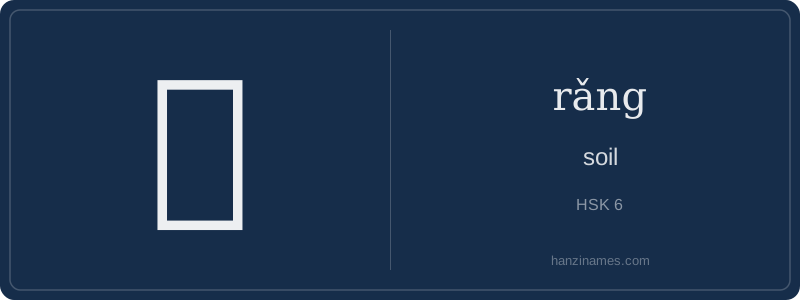
In modern China, 壤 appears most frequently in technical and formal contexts: soil conservation projects, agricultural research papers, and environmental legislation. It’s central to phrases like ‘土壤修复’ (soil remediation) and the national ‘土十条’ (Ten Measures for Soil Protection, issued in 2016). The idiom ‘膏腴之壤’ (gāoyú zhī rǎng)—meaning 'rich, fertile land'—dates back to the Warring States period and remains in use in historical writing and regional development reports.
The character is not pictographic; its form evolved from seal script where the right component 襄 represented phonetic borrowing and semantic association with ‘assisting growth’. Today, Chinese students encounter 壤 in geography textbooks describing the ‘黄壤’ (huáng rǎng, yellow soil) of Sichuan or ‘红壤’ (hóng rǎng, red lateritic soil) in Guangdong—real soil classifications used by the Chinese Academy of Agricultural Sciences.
Imagine standing barefoot on the loess plateau of Shaanxi Province—golden, crumbly soil stretching to the horizon under a hazy blue sky. This is 壤 (rǎng): not just dirt, but fertile, layered earth that has nourished millet farms for over 5,000 years. In classical Chinese, 壤 appears in texts like the Shu Jing (Book of Documents) to denote cultivated land—soil shaped by human labor and seasonal rhythms.
The character embodies ecological intimacy: Chinese agrarian philosophy sees 壤 as living medium—not inert matter, but a dynamic interface between heaven (rain), humanity (plowing), and earth (nutrients). Its 20 strokes mirror this complexity: the 土 radical grounds it literally and conceptually, while the right side (襄) hints at ‘encircling’ or ‘supporting’, suggesting soil’s role in sustaining life cycles.
At HSK Level 6, 壤 signals advanced lexical precision. Learners encounter it not in daily small talk, but in environmental policy reports, soil science papers, or literary descriptions of rural transformation. It’s the word used when China’s Ministry of Ecology and Environment publishes annual 'soil contamination assessment' (土壤污染状况评估)—where 壤 distinguishes scientifically classified earth from generic 土 (tǔ) or 泥 (ní, mud).
Example Sentences
Common Compounds
Similar Characters — Don't Mix These Up
Your First Step into Chinese Culture: Get a Chinese Name
Every journey into Chinese begins with a name. Use our free Chinese name generator to create a meaningful, personalized Chinese name that fits you perfectly.
Get My Chinese Name →