壮
Character Story & Explanation
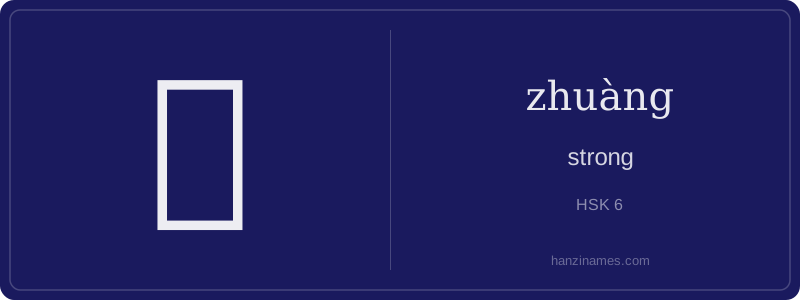
In daily life, 壮 appears most frequently in official, educational, and cultural contexts tied to China’s Zhuang ethnic group—the largest minority (18.5 million, 2020 census), concentrated in Guangxi Zhuang Autonomous Region. It features in institutional names like 广西壮族自治区 (Guǎngxī Zhuàngzú Zìzhìqū, Guangxi Zhuang Autonomous Region) and media outlets such as 壮文报 (Zhuang-language newspaper). The character also appears in idioms like 年富力强 (nián fù lì qiáng, 'in the prime of life'), where it contributes the sense of vigorous strength.
The character’s form is not pictographic but phono-semantic: 士 (shì, 'scholar/warrior') is the semantic radical, indicating association with human agency and status; the right component 曽 (cén, now simplified to 壮’s top-right stroke cluster) was historically phonetic but has diverged in pronunciation. Its current shape stabilized by the Song dynasty; no oracle bone or bronze script forms survive for this specific character.
As an archaeologist brushing dust from a Tang-dynasty stele in Guilin, I first encountered 壮 not as an ethnic label—but as a force: a character carved beside military rosters and frontier garrisons. Its early use in Han texts like the Shuowen Jiezi (100 CE) defines it as 'strong, robust, vigorous'—a semantic core rooted in physical and moral fortitude, not ethnicity. The radical 士 (scholar-warrior) anchors it in elite male virtue, while the 口 (mouth) and 巾 (cloth-like element, later stylized) suggest vocal assertion and ceremonial bearing.
This character did not originally denote an ethnic group. That meaning emerged gradually: during the Yuan and Ming dynasties, imperial gazetteers began using 壮 to transcribe local autonyms like *Bouxcuengh*, referencing communities in Guangxi’s mountainous west. By the 1950s, linguists and ethnographers formalized 壮 as the official Chinese name for the Zhuang people—reclaiming the character’s ancient connotation of strength to affirm cultural resilience.
What we uncover is layered time: the bronze-age ideal of martial-scholarly vigor, the medieval administrative adaptation to southern frontier societies, and the modern nation-state’s act of linguistic reclamation. 壮 is not a static glyph—it’s a palimpsest of statecraft, resistance, and identity-making across 2,000 years. Its six strokes hold both a soldier’s stance and a people’s self-naming.
Example Sentences
Common Compounds
Similar Characters — Don't Mix These Up
Your First Step into Chinese Culture: Get a Chinese Name
Every journey into Chinese begins with a name. Use our free Chinese name generator to create a meaningful, personalized Chinese name that fits you perfectly.
Get My Chinese Name →