央
Character Story & Explanation
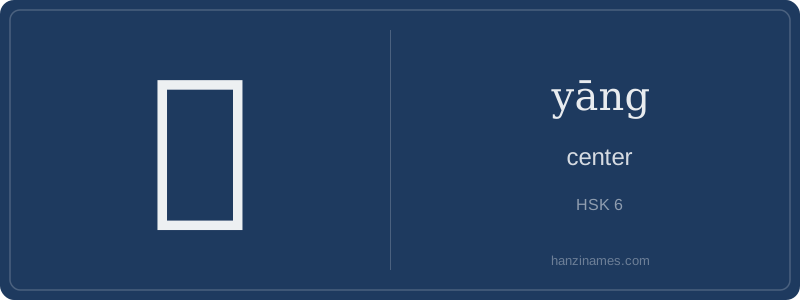
央 is almost never used alone in modern Mandarin—it appears exclusively in compounds, most famously 中央 (zhōngyāng), meaning 'central' or 'central government', e.g., 中央电视台 (CCTV). It’s deeply embedded in political, geographic, and institutional vocabulary: 中央银行 (central bank), 中央党校 (Party Central Party School). The idiom ‘央及’ (yāngjí) appears in classical texts like the *Zuo Zhuan*, meaning ‘to involve or implicate’—showing its early verbal use denoting extension from a center outward.
The character’s earliest verified form appears in Warring States bamboo slips (c. 475–221 BCE), where it consistently combines with 中 to mean ‘the central point of authority’. It is not a pictograph—no archaeological evidence supports a sun-or-peak origin. Instead, its structure (大 + two horizontal strokes + one vertical) evolved from earlier seal script variants emphasizing enclosure and centrality through symmetry and balance.
As an archaeologist brushing dust from a Han dynasty bamboo slip, I find 央 inscribed in elegant clerical script—not as a standalone word, but embedded in phrases like ‘中央’ (zhōngyāng), meaning ‘central authority’. Its five-stroke form—three horizontal lines cradled by the ‘big’ radical 大—suggests containment and centrality, not spatial geometry alone, but conceptual centrality: the axis of power, ritual, or cosmic order.
Excavations at Mawangdui revealed 央 in early medical texts describing ‘heart-qi converging at the yāng point’, revealing its ancient use in classical Chinese medicine to denote the vital convergence zone within the body. Unlike modern ‘center’ as a coordinate, 央 evokes resonance—where forces meet and harmonize. This semantic gravity persists: even today, 央 carries weight beyond mere location—it implies legitimacy, focus, and irreducible importance.
Crucially, 央 never appears alone in classical texts; it functions as a bound morpheme, always paired—zhōngyāng, bāngyāng, yāngyāng—to reinforce relational centrality. Its minimal stroke count (5) belies its maximal semantic load: a compact glyph encoding hierarchy, balance, and sanctioned authority. In oracle bone and bronze inscriptions, no attested form of 央 survives—its earliest secure appearance is in Warring States bamboo manuscripts, confirming it emerged as a refined abstract concept, not a pictograph of physical objects.
Example Sentences
Common Compounds
Similar Characters — Don't Mix These Up
Your First Step into Chinese Culture: Get a Chinese Name
Every journey into Chinese begins with a name. Use our free Chinese name generator to create a meaningful, personalized Chinese name that fits you perfectly.
Get My Chinese Name →