奉
Character Story & Explanation
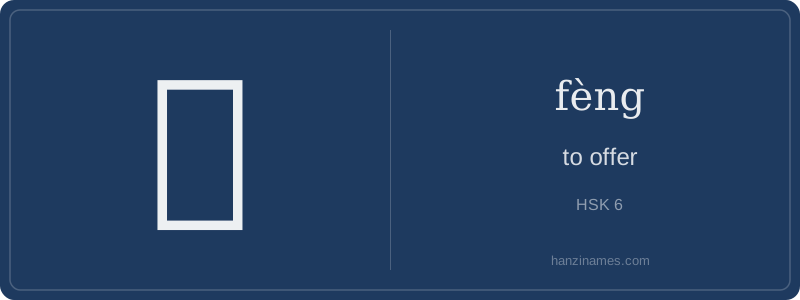
奉 is widely used in formal, respectful contexts: in government documents (e.g., 奉命 'ordered by authority'), ceremonial language (奉茶 'serving tea as a sign of respect'), and classical idioms like 奉公守法 ('uphold public duty and abide by law'). It appears in the HSK 6-level phrase 奉献精神 ('spirit of dedication'), frequently invoked in education and public discourse. Historically, it appears in pre-Qin bronze inscriptions denoting ritual presentation to ancestors or sovereigns.
The character evolved from seal script, where it depicted hands holding a sacrificial vessel beneath a roof-like element (+卩+廾), later simplified. While its earliest forms aren’t pictographic sun/moon motifs, scholars agree its structure emphasizes ‘hands presenting upward’—a documented semantic motif in ancient ritual scripts, reflecting its enduring association with reverent presentation.
At its core, 奉 (fèng) embodies a deeply relational ethic in Chinese thought—offering is never transactional but an act of reverence, humility, and alignment with higher principles. Unlike casual giving, 奉 implies ceremonial intentionality: whether presenting tea to elders, submitting documents to authorities, or honoring ancestors, the gesture affirms hierarchy, gratitude, and moral duty. This reflects Confucian ideals where proper conduct (lǐ 礼) transforms everyday actions into ethical expressions.
The character’s radical 大 (dà, 'great') signals that true offering arises from a magnanimous, self-transcending posture—not from obligation, but from recognizing something greater than oneself. Its eight strokes unfold like a ritual bow: deliberate, measured, and grounded. In classical texts, 奉 often appears in contexts of state service or filial piety, reinforcing that virtue is enacted through respectful action, not abstract belief.
Culturally, 奉 reveals how Chinese worldview embeds ethics in form and function. The same character governs both sacred rites and bureaucratic protocol—blurring lines between spiritual devotion and civic responsibility. To 奉 is to orient oneself within webs of reciprocity: receiving life from parents, wisdom from teachers, order from rulers, and harmony from Heaven. Thus, offering becomes a microcosm of cosmic alignment—small gestures echoing grand cosmological principles.
Example Sentences
Common Compounds
Similar Characters — Don't Mix These Up
Your First Step into Chinese Culture: Get a Chinese Name
Every journey into Chinese begins with a name. Use our free Chinese name generator to create a meaningful, personalized Chinese name that fits you perfectly.
Get My Chinese Name →