奏
Character Story & Explanation
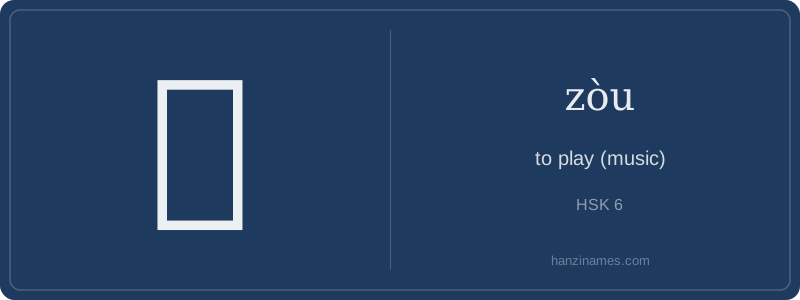
奏 is widely used today in formal and artistic contexts: concert programs list 曲目(演奏者)as ‘pieces (to be) performed’, and news headlines say ‘国家交响乐团奏响贝多芬’ ('The National Symphony Orchestra played Beethoven'). It appears in the idiom 奏效 (zòu xiào, 'to take effect'), where 奏 retains its sense of ‘putting into action’ — showing semantic extension beyond music. In government documents, 奏 can also mean ‘to submit a memorial’, reflecting its ancient bureaucratic use.
The character’s earliest attested form (in bronze inscriptions, c. 1000 BCE) shows a hand holding a drumstick over a drum (鼓), evolving into today’s structure. By the Han dynasty, the top became standardized as 大 + 一 + 丷, representing a ceremonial gesture of offering — aligning with its dual meanings: playing music *and* submitting reports to rulers.
Hi students! The character 奏 (zòu) is a Level 6 HSK word — it’s not beginner-friendly, but very rewarding to master. At its core, 奏 means 'to play (a musical instrument)' — think of a musician performing on the guqin or erhu. It carries a formal, respectful tone, often used in classical contexts or official performances, not casual jam sessions. Notice how it’s not just about sound: 奏 implies intention, skill, and presentation — like offering music with purpose.
Let’s break down its structure: it has 9 strokes and uses the 大 (dà, 'big') radical at the top — but don’t be misled! This isn’t about size. In ancient script, the top part evolved from a hand gesture () combined with 大, symbolizing ‘presenting’ or ‘offering’ — which fits perfectly with playing music as an act of offering, especially in ritual or court settings.
Don’t confuse 奏 with everyday words like 弹 (tán, 'to pluck/press') or 演 (yǎn, 'to perform'). 奏 is more solemn and literary — you’ll see it in phrases like 奏乐 (zòu yuè, 'to play music') or historical texts describing imperial ceremonies. As you advance, recognizing 奏 helps unlock classical Chinese poetry and formal modern writing — so practice its stroke order carefully, and connect it to the idea of ‘music offered with care.’
Example Sentences
Common Compounds
Similar Characters — Don't Mix These Up
Your First Step into Chinese Culture: Get a Chinese Name
Every journey into Chinese begins with a name. Use our free Chinese name generator to create a meaningful, personalized Chinese name that fits you perfectly.
Get My Chinese Name →