婪
Character Story & Explanation
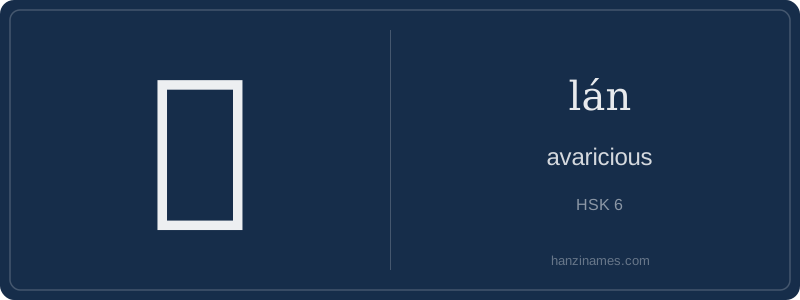
婪 is overwhelmingly used in fixed compounds—especially 贪婪 (tān lán, 'avaricious')—in formal writing, news media, and political discourse. It appears in official Xinhua News Agency reports condemning corruption (e.g., '贪婪的权力观' — 'an avaricious view of power') and in HSK-6 reading passages analyzing moral philosophy. The character is absent from colloquial speech; no native speaker says '他很婪'—it’s grammatically and stylistically incorrect outside compounds.
The character combines 女 (nǚ, 'woman') as semantic radical and 林 (lín, 'forest') as phonetic component. While some older sources speculated about gendered connotations, modern lexicographers (e.g., Xiandai Hanyu Cidian, 7th ed.) treat 女 here as a conventional classifier for abstract human traits—not a sexist marker. Its origin is purely phono-semantic; no pictographic or oracle-bone form survives.
Imagine walking through Beijing’s Panjiayuan Antique Market, where vendors hawk Ming-style ceramics and Qing dynasty scrolls. A collector haggles fiercely over a jade seal—his eyes gleaming not with appreciation, but calculation. He dismisses the seller’s plea for fairness, insisting on a price that strips away all margin. This isn’t passion—it’s 婪 (lán): the cold, insatiable hunger for more, beyond need or reason.
婪 appears in classical texts like the Book of Rites (Lǐjì), where it describes moral failure—not mere greed, but the erosion of propriety when desire overrides conscience. Unlike general terms for ‘greedy’, 婪 carries literary weight and ethical gravity, often reserved for critiques of power: corrupt officials hoarding wealth, scholars chasing titles at the cost of integrity, or dynasties collapsing under excess.
In modern usage, 婪 rarely stands alone. It’s almost always paired—most famously in 贪婪 (tān lán), a compound reinforcing intensity: ‘greed upon greed’. Its presence signals condemnation, not description. You’ll find it in CCTV documentaries exposing embezzlement, in Xi Jinping’s anti-corruption speeches quoting Confucian warnings, and in editorials labeling exploitative algorithms as ‘data 婪’—a neologism underscoring systemic appetite.
Example Sentences
Common Compounds
Similar Characters — Don't Mix These Up
Your First Step into Chinese Culture: Get a Chinese Name
Every journey into Chinese begins with a name. Use our free Chinese name generator to create a meaningful, personalized Chinese name that fits you perfectly.
Get My Chinese Name →