嫌
Character Story & Explanation
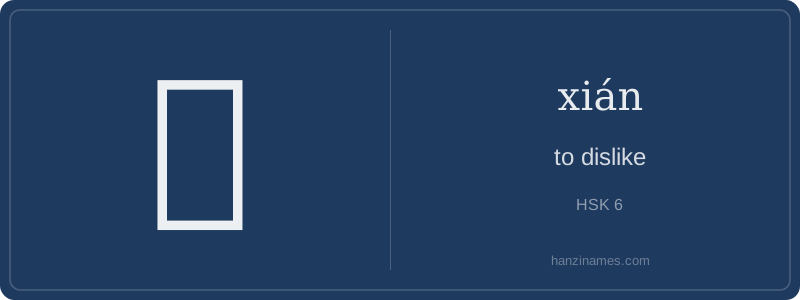
In Shanghai’s bustling Yuyuan Market, a young vendor proudly displays hand-painted fans—but an elderly customer frowns, muttering, '这颜色太艳,嫌俗气。' (Zhè yánsè tài yàn, xián súqì.) — 'These colors are too flashy; they feel tacky.' Here, 嫌 functions as a colloquial verb meaning 'to find objectionable'—a subtle yet loaded judgment rooted in aesthetic and generational values. This usage is documented across dialects and formal registers: from classical poetry to CCTV news reports citing public opinion ('网民嫌广告太多', 'netizens find ads excessive').
The character’s form has no pictographic origin; it’s a phono-semantic compound: 女 (nǚ, 'female') serves as semantic indicator (historically linking disapproval to gendered social norms), while 兼 (jiān) provides phonetic approximation. No oracle bone or bronze script forms exist—its earliest attestation is in seal script (c. 3rd century BCE), confirming its late emergence among common characters.
The character 嫌 (xián) carries the core meaning 'to dislike' or 'to find objectionable'—not merely neutral disinterest, but a conscious, often socially charged aversion. It appears in contexts where judgment, prejudice, or subjective distaste is expressed—like rejecting a job candidate for being 'too old', or criticizing a dish as 'too salty'. Its emotional weight lies in implied criticism, making it common in interpersonal friction, media commentary, and legal language (e.g., 'suspected of' in criminal contexts).
Etymologically, 嫌 combines the female radical 女 with 兼 (jiān), originally meaning 'to hold two things at once'. In ancient usage, this suggested 'holding conflicting feelings'—ambivalence bordering on aversion. Over time, the nuance sharpened: by the Han dynasty, 嫌 consistently denoted 'to regard with suspicion or distaste', appearing in texts like the *Shuōwén Jiězì* (121 CE) as 'disliking what is improper'. Its semantic field overlaps with doubt, bias, and moral disapproval.
Unlike generic verbs like 不喜欢 (bù xǐhuan, 'don’t like'), 嫌 implies agency and often social consequence—it’s the word used when someone *actively objects*, not just feels indifferent. This makes it vital for understanding Chinese discourse on fairness, discrimination, and etiquette. In modern Mandarin, it frequently appears in compound verbs (e.g., 嫌弃, 嫌恶) and passive constructions ('被嫌', 'is disliked'), revealing how deeply cultural attitudes toward acceptability are encoded in grammar and vocabulary.
Example Sentences
Common Compounds
Similar Characters — Don't Mix These Up
Your First Step into Chinese Culture: Get a Chinese Name
Every journey into Chinese begins with a name. Use our free Chinese name generator to create a meaningful, personalized Chinese name that fits you perfectly.
Get My Chinese Name →