娇
Character Story & Explanation
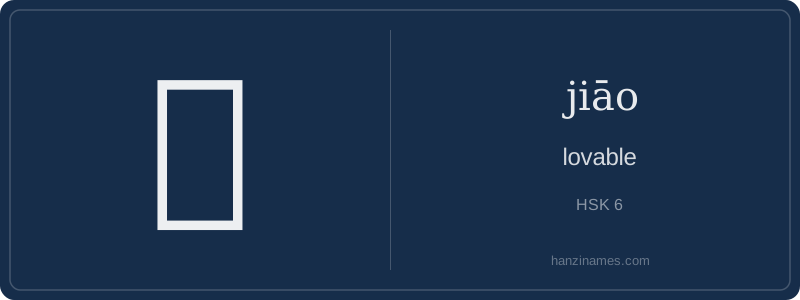
娇 is widely used in modern Mandarin to describe people (often women or children) with endearing delicacy—e.g., 娇气 (jiāoqì, 'spoiled temperament') or 娇嫩 (jiāonèn, 'tender, delicate'). It appears in classical poetry (e.g., Tang dynasty works describing floral beauty) and remains common in contemporary speech, especially in parental or affectionate address ('小娇娇', xiǎo jiāojiāo, a cutesy reduplicated term). The idiom 娇生惯养 (jiāoshēngguànyǎng, 'raised with excessive indulgence') is frequently used in education and parenting discussions.
The character combines the 女 (nǚ, 'female') radical with the phonetic component 乔 (qiáo), meaning 'tall' or 'lofty'—but here serving primarily for sound. Its earliest attested form appears in Han dynasty bamboo slips, already with the semantic 'female' + phonetic structure. No pictographic origin exists; it's a phono-semantic compound, standardized by the Qin dynasty script reforms.
The Chinese character 娇 (jiāo) conveys a nuanced, culturally rich sense of 'lovable'—emphasizing delicate charm, endearing vulnerability, or gentle refinement. Unlike English adjectives like 'cute' or 'adorable', which often prioritize visual appeal or youthfulness, 娇 carries emotional resonance tied to tenderness, nurtured grace, and socially sanctioned softness—especially in feminine contexts. It reflects Confucian-influenced ideals where modesty, poise, and emotional expressiveness are valued as cultivated virtues, not mere traits.
Western equivalents like 'winsome', 'demure', or 'dainty' come closest—but none fully capture 娪’s embedded cultural weight. 'Winsome' hints at charm but lacks the implied social expectation; 'demure' leans toward restraint rather than affectionate allure. 娇 is also performative: it appears in compliments ('她很娇'—'She’s so lovely') and critiques ('太娇了'—'Too spoiled/fragile'), revealing how admiration and concern intertwine in Chinese discourse around sensitivity and resilience.
This duality makes 娇 both intimate and evaluative. In literature and media, it describes heroines whose strength lies in emotional authenticity—not stoicism—and whose 'lovable' quality invites protection *and* respect. Unlike Western 'strong female leads' who often reject softness, 娇-embodied characters wield gentleness as agency. Thus, 娇 isn’t passive charm—it’s a culturally coded form of relational power, rooted in harmony, reciprocity, and the quiet confidence of being genuinely cherished.
Example Sentences
Common Compounds
Similar Characters — Don't Mix These Up
Your First Step into Chinese Culture: Get a Chinese Name
Every journey into Chinese begins with a name. Use our free Chinese name generator to create a meaningful, personalized Chinese name that fits you perfectly.
Get My Chinese Name →