宰
Character Story & Explanation
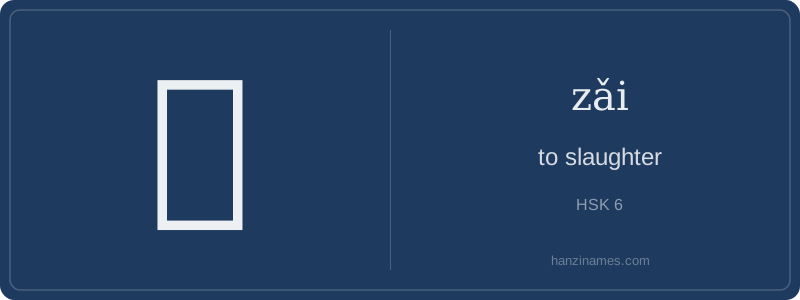
In modern Chinese, 宰 is rarely used literally for slaughter outside formal or literary contexts. Its dominant contemporary use is slang: 宰人 (zǎi rén) means 'to rip someone off'—e.g., a taxi driver overcharging, or a vendor inflating prices. This metaphorical extension (from 'butcher' → 'exploit') is widespread, documented in dictionaries like the Xiandai Hanyu Cidian (7th ed.) and attested in media since the 1980s. It appears in headlines, social media, and daily complaints.
The character’s earliest attested form (Western Zhou bronze inscriptions) shows 宀 over 辛—where 辛 originally represented a tattooing or execution tool, not a phonetic. Scholars like Li Xiaoding confirm 辛’s association with punishment and official authority. Thus, 宰’s core ancient meaning was ‘official in charge of penal or sacrificial duties’—not a butcher by trade, but a state-appointed executor of ritual or justice.
As an archaeologist sifting through oracle-bone and bronze inscriptions, I found 宰 etched not as a butcher’s knife—but as a ritual administrator. Early Western Zhou texts show 宰 denoting high-ranking stewards who managed royal sacrifices, overseeing the selection, preparation, and offering of animals. Its semantic weight lies in authority over life-and-death rites—not brute force, but sacred delegation.
This character’s evolution reveals a profound semantic shift: from ‘ritual supervisor’ (Shang–Zhou) to ‘to slaughter’ (Warring States onward). By the Han dynasty, bureaucratic titles like 太宰 (Grand Steward) coexisted with verbs meaning ‘to kill’—evidence that administrative control over sacrifice gradually lexicalized into violent action itself. The radical 宀 (roof) hints at domestic or ceremonial space—not open fields, but controlled, indoor rites.
The ten-stroke structure tells its own story: 宀 (roof) above 辛 (a chisel or executioner’s tool, later phonetic) and 十 (crossed strokes, possibly signifying division or ritual marking). No pictorial ox or blade appears—instead, it encodes institutional power. This isn’t gore captured in ink; it’s governance made manifest in meat, blood, and bureaucracy—where killing was never random, but always *assigned*.
Example Sentences
Common Compounds
Similar Characters — Don't Mix These Up
Your First Step into Chinese Culture: Get a Chinese Name
Every journey into Chinese begins with a name. Use our free Chinese name generator to create a meaningful, personalized Chinese name that fits you perfectly.
Get My Chinese Name →