宵
Character Story & Explanation
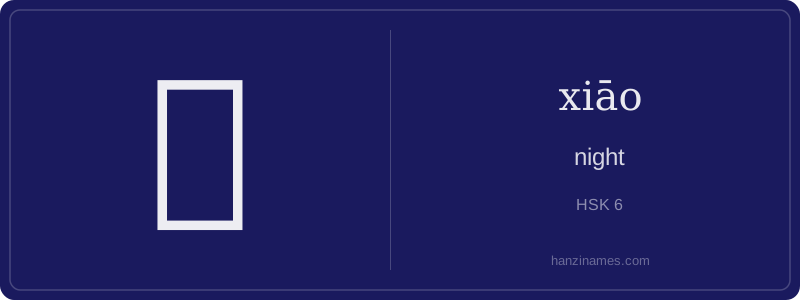
宵 appears predominantly in formal, literary, or institutional contexts—not daily speech. It’s essential in compound words like 宵禁 (xiāo jìn, 'night curfew') and 元宵 (yuán xiāo, 'Lantern Festival'), both documented since the Han and Tang dynasties respectively. The Lantern Festival, held on the 15th day of the first lunar month, is officially named 元宵节 (Yuánxiāo Jié) in state media and historical records such as the Book of Han and Song-era Dreams of the Red Chamber.
The character’s seal-script origin shows 宀 (roof) over 小 (small) and 月 (moon)—a semantic fusion meaning 'the moon’s early, sheltered appearance at nightfall'. This reflects its core sense: the quiet, structured beginning of night—not midnight or deep darkness, but the transitional, watchful hours after sunset.
As an archaeologist brushing dust from a Han dynasty bamboo slip, I find 宵 etched not as a mere time-marker, but as a cultural artifact of nocturnal ritual and imperial vigilance. Its roof radical 宀 signals sheltered, enclosed night—distinct from the open-sky darkness of 夜 (yè). Early texts use 宵 to denote the *first watch* after dusk, when lanterns were lit and officials began night patrols—a temporal unit embedded in governance, not just astronomy.
This character’s ten strokes encode precision: the top 宀 (roof) shelters 小 (small) + 月 (moon), suggesting ‘the moon’s small presence at the onset of night’. Unlike poetic 夜 or colloquial 晚, 宵 carries bureaucratic weight—seen in Qin legal manuscripts specifying ‘宵禁’ (night curfew) enforcement. Its form stabilized by the Eastern Han, reflecting standardization under imperial script reform.
Excavated seals from Chang’an’s Western Market reveal 宵 stamped on tax receipts dated ‘the third night-watch’, proving its administrative function. Even in Tang poetry, 宵 evokes disciplined stillness—Li Bai writes of ‘宵漏未阑’ (the night-watch clepsydra not yet run dry), tying timekeeping to cosmic order. To read 宵 is to hold a calibrated lens into ancient China’s rhythm: not just darkness, but measured, governed, luminous night.
Example Sentences
Common Compounds
Similar Characters — Don't Mix These Up
Your First Step into Chinese Culture: Get a Chinese Name
Every journey into Chinese begins with a name. Use our free Chinese name generator to create a meaningful, personalized Chinese name that fits you perfectly.
Get My Chinese Name →