寝
Character Story & Explanation
In modern Chinese, 寝 appears most frequently in formal, institutional, or written contexts—not daily conversation. It’s standard in public notices (e.g., hospital signs: '请保持安静,病人正在就寝'), school dormitory schedules ('晚自习后22:30就寝'), and official documents. A well-documented idiom is 废寝忘食 (fèiqǐnwàngshí), meaning 'to neglect sleep and meals'—used since the Song dynasty to describe intense scholarly devotion (recorded in Zhu Xi’s writings). This phrase remains common in education and media today.
The character’s earliest attested form appears in bronze inscriptions from the Western Zhou period (c. 1046–771 BCE), where it depicted a person lying under a roof—confirming its original pictographic link to 'resting indoors.' While later forms evolved, the semantic logic (roof + rest) remained intact across millennia.
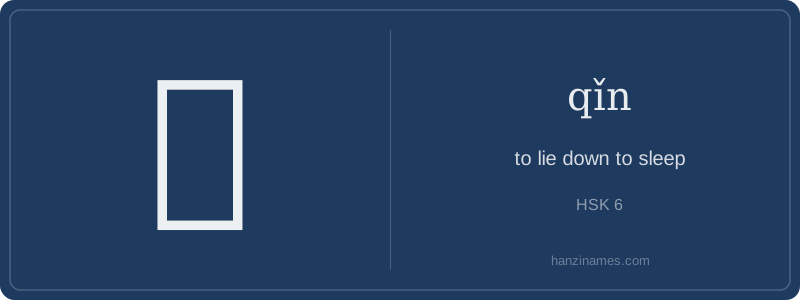
Hi students! Let’s explore 寝 (qǐn), a character that means 'to lie down to sleep or rest.' Though it looks formal, it’s essential for understanding written Chinese—especially in literature, news, and formal speech. Unlike the everyday word 睡 (shuì), which is used in casual talk like 'I’m going to sleep,' 寝 appears in more refined contexts: official notices, historical texts, or compound words like 就寝 (jiùqǐn, 'to go to bed'). Its tone (third tone) is important—practice saying 'qǐn' with a dipping pitch!
This character belongs to HSK Level 6, meaning it’s among the most advanced vocabulary learners encounter. But don’t be intimidated! Its structure is logical: the roof radical 宀 (mián) signals 'a sheltered space,' hinting at an indoor, private act—like resting in a room. The bottom part 侵 (qīn) originally meant 'to encroach,' but here it serves mainly as a phonetic clue. That’s common in Chinese: radicals hint at meaning, components hint at sound.
As you learn 寝, notice how it rarely stands alone in modern speech—it’s almost always in compounds. You’ll see it in signs ('请勿喧哗,病人正在就寝'), school rules ('熄灯就寝时间'), or even medical reports ('夜间睡眠及就寝情况'). Think of it as the 'literary cousin' of 睡: same core idea, different register. Mastering it helps you read newspapers, understand health advisories, and appreciate classical poetry where characters like this carry quiet dignity.
Example Sentences
Common Compounds
Similar Characters — Don't Mix These Up
Your First Step into Chinese Culture: Get a Chinese Name
Every journey into Chinese begins with a name. Use our free Chinese name generator to create a meaningful, personalized Chinese name that fits you perfectly.
Get My Chinese Name →