审
Character Story & Explanation
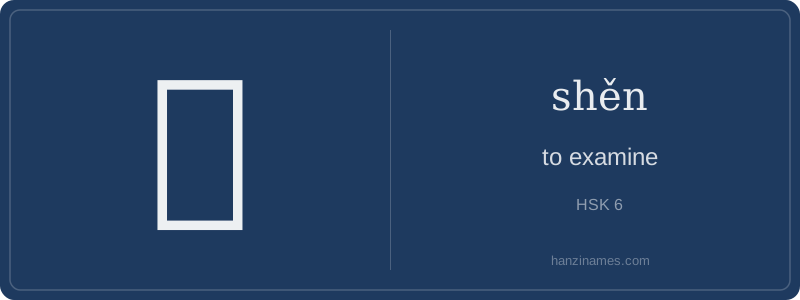
审 is central to modern Chinese institutional language: it appears in official documents, news reports, and legal proceedings. The phrase 审查制度 (shěnchá zhìdù, 'review system') refers to China’s content oversight framework, widely documented in government white papers and media regulations. Another common usage is in education — university thesis defense is called 论文答辩与审核 (lùnwén dábiàn yǔ shěnhé, 'thesis defense and review').
Historically, 审 evolved from seal script (c. 3rd c. BCE), where it combined 宀 (roof, symbolizing authority) and 申 (shēn, 'to state clearly' or 'to extend' — also a phonetic component). There’s no verified oracle-bone form, but by the Han dynasty, it consistently meant 'to examine thoroughly' in legal texts like the *Book of Han*. Today, Chinese people use it daily in contexts like visa application reviews (签证审核, qiānzhèng shěnhé) or software app store approvals.
Hi students! Let’s learn 审 (shěn), a Level 6 HSK character meaning 'to examine' or 'to review'. It’s not just about looking — it carries weight: careful scrutiny, official inspection, or judicial review. Think of a judge reading evidence or an editor checking a manuscript. Its radical 宀 (mián) means 'roof', suggesting something happening under shelter — like formal deliberation in a courtroom or office. That helps you remember its serious, procedural tone.
This character appears in high-stakes contexts: legal, academic, and administrative. You’ll rarely hear it in casual chat — it’s formal and precise. Unlike simpler verbs like 看 (kàn, 'to look'), 审 implies method, authority, and consequence. Mastering it unlocks vocabulary like 审查 (shěnchá, 'censorship') and 审判 (shěnpàn, 'trial') — essential for understanding Chinese law, media, and governance.
Don’t confuse 审 with similar-sounding words. Its 8 strokes follow a clear order: start with the roof radical (宀), then the inner components — first the horizontal stroke, then the vertical, then the two dots and final hook. Practice writing it slowly while saying 'shěn' aloud. Each stroke anchors your memory: roof → structure → scrutiny. With repetition and real-world examples, this character will feel logical — not intimidating!
Example Sentences
Common Compounds
Similar Characters — Don't Mix These Up
Your First Step into Chinese Culture: Get a Chinese Name
Every journey into Chinese begins with a name. Use our free Chinese name generator to create a meaningful, personalized Chinese name that fits you perfectly.
Get My Chinese Name →