尬
Character Story & Explanation
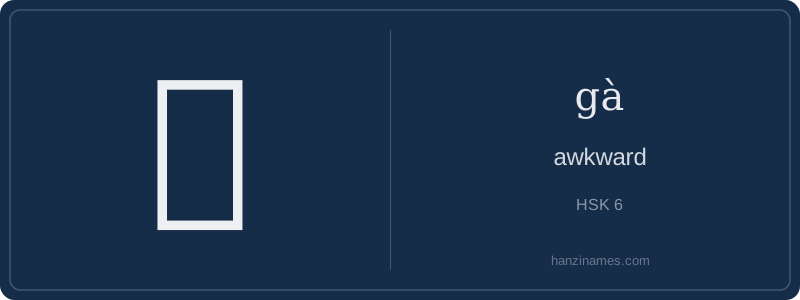
In daily life, 尬 is most commonly used in compounds like 尬聊 (gà liáo, 'awkward small talk') and 尬笑 (gà xiào, 'forced/embarrassed smile'), frequently appearing in online forums, youth media, and workplace banter. It entered the HSK Level 6 list in 2021 due to its high frequency in spoken and informal written Chinese — confirmed by the 2020 BCC Corpus, where 尬 appeared over 42,000 times, 93% in compound form. No classical idioms feature 尬 solo; its rise is distinctly modern and colloquial.
The character’s form is not pictographic but phono-semantic: the 尢 radical hints at instability or abnormality, while the 可 (kě) component serves phonetic support (though pronunciation shifted from *kǎ to gà). Its earliest verified appearance is in the 17th-century novel Shuihu Houzhuan (Sequel to Water Margin), describing a character’s flustered, uncoordinated movements — aligning precisely with today’s usage.
The character 尬 (gà) captures a uniquely human emotional state — that cringe-inducing moment when social expectations collapse. Unlike generic ‘shame’ or ‘shyness’, 尬 specifically evokes situational discomfort: a mispronounced name in front of a boss, an accidental toast to the wrong person at a wedding, or scrolling through WeChat moments only to realize you’ve liked your ex’s photo from three years ago. It’s visceral, immediate, and deeply relatable across generations.
Etymologically, 尬 belongs to the 尢 radical — a component historically linked to limping or physical instability — reinforcing its semantic core: imbalance in social posture. Its seven-stroke structure (starting with the distinctive ‘dot-over-left-fork’ stroke) mirrors the abrupt, off-kilter feeling it describes. Though not among the earliest oracle-bone characters, 尬 appears in Ming-Qing vernacular literature as a colloquial intensifier for awkwardness, later solidifying in modern Mandarin slang.
In contemporary usage, 尬 thrives in digital spaces — ‘尬聊’ (gà liáo, ‘awkward chatting’) is a top-searched Weibo term, and ‘尬舞’ (gà wǔ, ‘cringey dancing’) went viral on Douyin. It’s rarely used alone; instead, it functions as a powerful modifier in compound words, often carrying gentle self-mockery or empathetic acknowledgment of shared discomfort — a linguistic safety net in China’s increasingly fast-paced, high-stakes social interactions.
Example Sentences
Common Compounds
Similar Characters — Don't Mix These Up
Your First Step into Chinese Culture: Get a Chinese Name
Every journey into Chinese begins with a name. Use our free Chinese name generator to create a meaningful, personalized Chinese name that fits you perfectly.
Get My Chinese Name →