尸
Character Story & Explanation
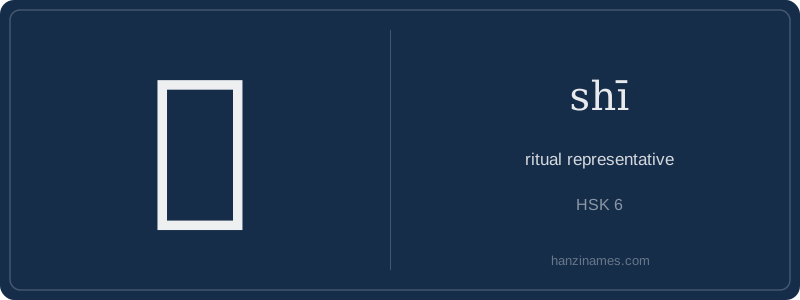
In pre-Qin and early imperial China, 尸 referred specifically to a living person—often a young male descendant—who sat motionless during ancestral sacrifices to symbolically host the ancestor’s spirit. Documented in the Book of Rites (Lǐjì) and Zuo Zhuan, this practice declined after the Han dynasty as Confucian orthodoxy shifted toward prayer-based veneration. Today, 尸 appears almost exclusively in classical texts, historical discussions, or fixed expressions like 尸位素餐.
The character is a pictograph: oracle bone and bronze inscriptions show a simplified human figure lying supine or seated with bent legs—emphasizing stillness and ritual posture, not death itself. Its three-stroke form (尸) evolved directly from this early depiction, retaining the curved 'back' and 'legs' structure. No modern native speaker encounters it in daily speech; its relevance is scholarly or literary.
The Chinese character 尸 (shī) is a radical and standalone character meaning 'person representing the deceased'—a ritual role in ancient Chinese ancestral ceremonies, not 'corpse' in the literal sense. Historically, this individual sat silently during rites to embody the spirit of the departed, serving as a sacred medium between living and dead. Its usage reflects Confucian emphasis on filial piety and ritual propriety (lǐ), where embodied presence mattered more than physical remains.
Unlike Western funerary traditions that center on burial, mourning, or memorialization of absence, 尸 represents active spiritual continuity: the deceased is ritually 'present' through a living stand-in. This contrasts sharply with Christian notions of soul ascension or secular memorial services focused on memory rather than embodiment. The role was highly formalized—only certain kin could serve, and strict protocols governed posture, silence, and offerings.
In modern Mandarin, 尸 rarely appears outside compound words or classical allusions, and its original ritual meaning is largely archaic. However, it survives in idioms like 尸位素餐 (shī wèi sù cān), meaning 'to occupy a position without performing duties'—a metaphorical extension from 'sitting in place as a symbolic figurehead.' This semantic shift mirrors how ritual roles evolved into bureaucratic critique, preserving cultural memory through linguistic metaphor.
Example Sentences
Common Compounds
Similar Characters — Don't Mix These Up
Your First Step into Chinese Culture: Get a Chinese Name
Every journey into Chinese begins with a name. Use our free Chinese name generator to create a meaningful, personalized Chinese name that fits you perfectly.
Get My Chinese Name →