屁
Character Story & Explanation
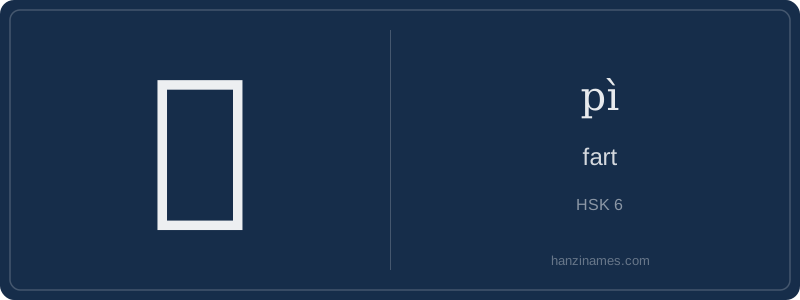
In modern Chinese, 屁 is overwhelmingly colloquial and informal—rare in formal writing but ubiquitous in speech, internet slang, and expressive idioms. It appears in fixed phrases like 放屁 (fàng pì, 'to fart') used literally or figuratively ('nonsense!'), and 胡说八道 (húshuō bādào) often paired with 屁话 (pìhuà, 'bullshit'). Historical texts rarely use it seriously; instead, Ming-Qing vernacular novels (e.g., Golden Lotus) deploy it for comic realism. Contemporary usage leans heavily on irony and self-deprecation—e.g., '我算个屁' (wǒ suàn gè pì, 'I’m nobody') expresses humility with earthy force.
The character has no verified pictographic origin—it’s a late-developing phono-semantic compound. No oracle bone or bronze script forms exist. Instead, picture this real-life scene: A WeChat group chat explodes after someone posts an absurd claim; three replies instantly fire back: '放屁!' '纯属放屁!' '这简直是屁话!'—all deploying 屁 for emphatic, culturally coded dismissal.
Our detective begins at the crime scene: the character 屁 (pì), meaning 'fart'. At first glance, it’s unassuming—just seven strokes, a 尸 (corpse) radical on the left and 比 (to compare) on the right. But why would 'fart' be linked to 'corpse'? The radical 尸 here isn’t morbid—it’s a phonosemantic placeholder, historically used for words related to the lower body or excretion, not death. Its shape evolved from ancient scripts depicting a person in a crouched posture, later stylized into today’s 'corpse' form.
The right component 比 (bǐ) serves mainly as a phonetic clue—though modern pronunciation diverges (pì vs. bǐ), this reflects centuries of sound shifts in Middle Chinese. Linguists confirm that 屁 belongs to a group of characters where 比 once approximated the *p- sound in Old Chinese dialects. No oracle bone or bronze inscription contains 屁; it first appears reliably in Han dynasty dictionaries like the Shuōwén Jiězì (c. 100 CE), classified under 尸 and defined plainly as 'qì xià chū' (gas exiting downward).
This character is a textbook example of how Chinese orthography prioritizes functional literacy over literal imagery. It’s not pictographic—no wind, no buttocks, no cartoonish puff. Instead, it’s a pragmatic compromise: a familiar radical signals semantic domain (bodily functions), while a familiar phonetic hints at pronunciation. Its persistence across 2,000 years testifies less to elegance and more to utility—people needed a way to write 'fart' clearly, even if humorously, and 屁 delivered with linguistic economy.
Example Sentences
Common Compounds
Similar Characters — Don't Mix These Up
Your First Step into Chinese Culture: Get a Chinese Name
Every journey into Chinese begins with a name. Use our free Chinese name generator to create a meaningful, personalized Chinese name that fits you perfectly.
Get My Chinese Name →