屑
Character Story & Explanation
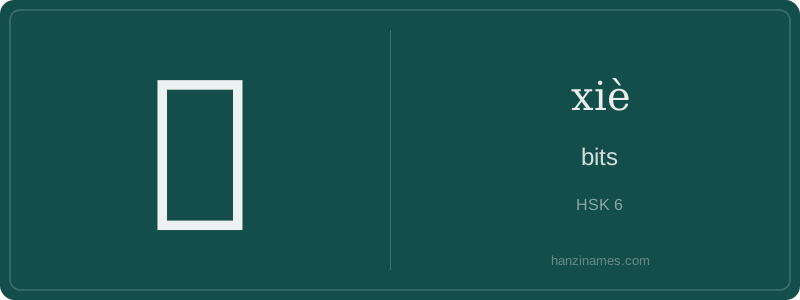
In modern China, 屑 appears most commonly in compound words like 碎屑 (suìxiè, 'debris') and 不屑 (bùxiè, 'to disdain'). The idiom 不屑一顾 ('not worth a glance') is widely used in formal writing and media to express contemptuous dismissal—e.g., a critic rejecting sensationalist headlines. Historically, 屑 appears in Tang dynasty poetry describing fallen blossoms and Song-era agricultural manuals noting grain chaff (谷屑). It’s also standard in technical contexts: national standards (GB/T) for food safety reference 'foreign matter and residue (杂质及屑)'.
The character is not pictographic; its origin is semantic-phonetic (形声). The 尸 radical suggests a connection to the human body or groundedness, while the phonetic component 屰 (nì, now obsolete) indicated pronunciation. Today, Chinese learners encounter 屑 most often when reading essays on social values—or watching chefs in Chengdu Sichuan restaurants meticulously sift chili powder to remove coarse flakes (辣屑), ensuring perfect mouthfeel.
Imagine a bustling Beijing hutong kitchen at dawn: flour dust hangs in slanted sunlight, and Grandma Li sweeps rice grains and tea leaf fragments—tiny, discarded bits—from her worn wooden table. These fragments are 屑 (xiè): not waste, but evidence of life’s quiet labor. In classical and modern Chinese, 屑 refers to small, often negligible pieces—of food, metal, wood, or even abstract things like dignity or attention. It carries subtle weight: something so small it’s easily overlooked, yet essential to texture and truth.
The character’s radical 尸 (shī), meaning 'corpse' or 'person in ritual posture', hints at its original sense: remnants left behind after the body—or substance—is gone. Over time, 屑 narrowed to mean physical fragments, then extended metaphorically: to dismiss someone as 'not worth a shred' (不屑一顾). Its ten strokes form a compact, slightly top-heavy shape—like crumbs tumbling downward—reinforcing its association with fallen, residual matter.
Though rare in casual speech, 屑 appears in precise contexts: metallurgy (metal shavings), culinary texts (crumb size in pastries), and literary critique (dismissing shallow arguments). At HSK 6, it signals advanced lexical awareness—not just vocabulary, but sensitivity to nuance. Learners who master 屑 grasp how Chinese conveys value through scale: what’s 'bit-sized' may be trivial… or the very thing that reveals integrity, like tea leaves settling to show true flavor.
Example Sentences
Common Compounds
Similar Characters — Don't Mix These Up
Your First Step into Chinese Culture: Get a Chinese Name
Every journey into Chinese begins with a name. Use our free Chinese name generator to create a meaningful, personalized Chinese name that fits you perfectly.
Get My Chinese Name →