帖
Character Story & Explanation
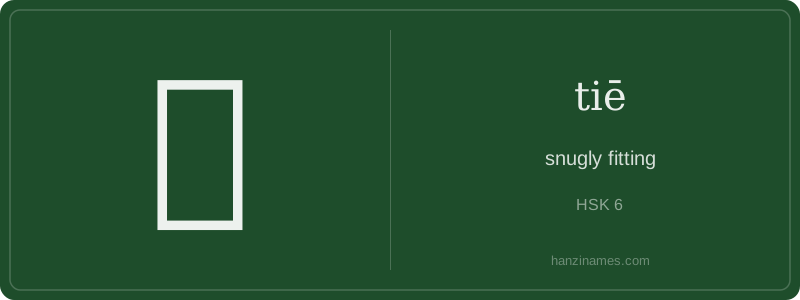
In contemporary China, 帖 appears most frequently in two real-world contexts: wedding invitation cards (喜帖 xǐ tiě) and calligraphy practice sheets (字帖 zì tiè). The term 字帖 is standardized in national curriculum guidelines for primary art education and appears in textbooks published by People’s Education Press. Historical records from the Song Dynasty document imperial libraries collecting famous calligraphic 帖, such as the Ritual Vessel Inscription rubbings, treated as authoritative models for centuries.
The character’s written form is not pictographic but phono-semantic: 巾 (cloth radical) signals material context (soft, pliable surfaces), while 兑 (duì) serves as the phonetic component — though its modern pronunciation diverges, this reflects regular sound shifts in Middle Chinese. No oracle bone or bronze script forms exist; 帖 first appears in clerical script during the Han Dynasty, consistently used for ‘notices’ and ‘models’.
The character 帖 (tiē) evokes the quiet precision of something settling perfectly into place — like a silk handkerchief smoothed over a lacquered box, or a freshly printed calligraphy rubbing pressed evenly onto rice paper. Its radical 巾 (jīn), meaning 'cloth' or 'towel', hints at softness and conformity, while the right-side component 兑 (duì) historically relates to exchange and fulfillment — suggesting harmony between form and function. This duality underpins its core sense: fitting snugly, without gap or strain.
Though often overlooked in beginner textbooks, 帖 carries nuanced weight in Chinese aesthetics and daily life. In calligraphy, a 帖 refers to a model manuscript — not just any copy, but one whose strokes 'fit' the master’s intent so precisely that learners trace it as if their brush were guided by the original’s invisible hand. That ‘snug fit’ is both physical (ink adhering to paper) and conceptual (the student’s understanding aligning with tradition).
Its three pronunciations reflect functional specialization: tiē for ‘adhering’ or ‘fitting snugly’, tiě for formal notices (e.g., wedding invitations), and tiè for calligraphic models. This phonetic flexibility mirrors how Chinese characters evolve — same shape, shifting roles across registers. For HSK Level 6 learners, mastering 帖 means grasping not just vocabulary, but how language embodies cultural values: precision, respect for tradition, and the quiet satisfaction of things aligning just right.
Example Sentences
Common Compounds
Similar Characters — Don't Mix These Up
Your First Step into Chinese Culture: Get a Chinese Name
Every journey into Chinese begins with a name. Use our free Chinese name generator to create a meaningful, personalized Chinese name that fits you perfectly.
Get My Chinese Name →