帝
Character Story & Explanation
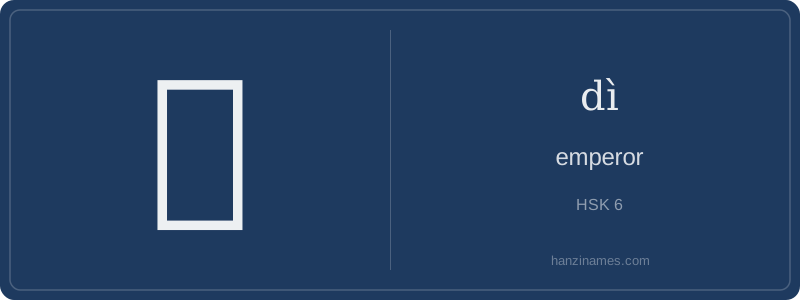
Historically, 帝 was used in official titles like 皇帝 (huángdì, 'emperor') — first adopted by Qin Shi Huang in 221 BCE to signify supreme, non-feudal authority. It appears in Confucian classics, imperial edicts, and temple inscriptions across dynasties. Today, it survives in formal terms like 帝国主义 (dìguó zhǔyì, 'imperialism') and idioms such as 帝王之术 (dìwáng zhī shù, 'the art of ruling'). You’ll also see it in historical dramas, museum labels, and academic texts — but never in casual speech or self-reference.
The character’s earliest attested form appears in bronze inscriptions (c. 1000 BCE), where it depicts a ceremonial altar topped with a cloth (巾), suggesting ritual authority rather than a pictograph of a person. Scholars agree its core components reflect divine legitimacy — not kingship by birth alone, but mandate from Heaven (天命). No oracle-bone form is confirmed; its Shang–Zhou evolution is documented in excavated bronzes and bamboo slips.
Hi students! The character 帝 (dì) means 'emperor' — not just any ruler, but the supreme sovereign of imperial China, like the Qing Dynasty emperors or the legendary Yellow Emperor. It carries deep historical weight and formal dignity. Though no longer used for living rulers, it appears frequently in history books, literature, and respectful titles — never casually. Pronounced with a fourth-tone falling pitch (dì), it’s essential to distinguish it from similar-sounding words like dī (low) or dǐ (bottom).
This character is classified as HSK Level 6, meaning it’s among the most advanced vocabulary — typically mastered after ~5,000 words. You’ll encounter it mainly in academic, historical, or classical contexts, not everyday conversation. Its 9 strokes follow a logical structure: top (立) suggests 'standing upright' (symbolizing authority), middle (冖) a ceremonial canopy, and bottom (巾) a ritual cloth — all reinforcing sovereignty and sacred office.
Don’t confuse 帝 with 王 (wáng, 'king') — while both denote rulers, 帝 implies heavenly mandate and universal rule, whereas 王 was historically subordinate (e.g., feudal lords). In modern usage, 帝 often appears in compound words like 帝国 (empire) or 帝王 (emperor), always retaining gravitas. Practice writing it slowly, paying attention to stroke order — especially the crucial horizontal stroke in the ‘stand’ component (立) and the final downward stroke of 巾.
Example Sentences
Common Compounds
Similar Characters — Don't Mix These Up
Your First Step into Chinese Culture: Get a Chinese Name
Every journey into Chinese begins with a name. Use our free Chinese name generator to create a meaningful, personalized Chinese name that fits you perfectly.
Get My Chinese Name →