它
Character Story & Explanation
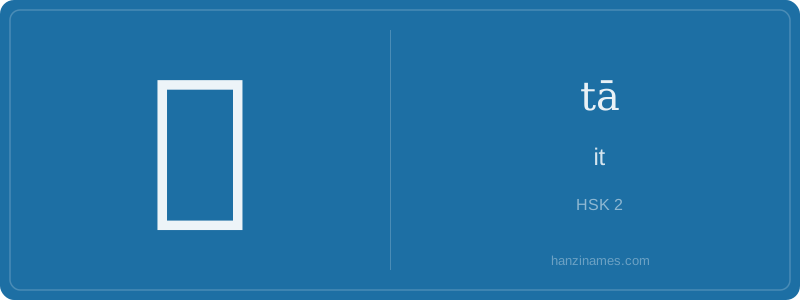
Historically, 它 emerged during the Warring States period (475–221 BCE) as a variant of the character 蛇 (shé, 'snake'), whose oracle-bone form depicted a serpent. Over time, the snake meaning faded, and 它 was repurposed as a neutral third-person pronoun by the Han dynasty—documented in texts like the *Shuōwén Jiězì* (121 CE). Today, it is indispensable in formal writing and speech for referring to animals, objects, concepts, and abstract entities—never people (who take 他 or 她).
The character’s modern form—宀 over 匕—is standardized and unambiguous. Its origin is well-documented: early bronze inscriptions show 它 with a curved line resembling a snake’s body under a roof-like canopy; later script reforms simplified it into today’s five-stroke structure. No mythic invention is needed—it evolved pragmatically to fill a grammatical need.
At first glance, 它 appears simple—a mere pronoun meaning 'it'. Yet its quiet presence reveals a profound Chinese linguistic philosophy: neutrality and relational context over inherent identity. Unlike English, which assigns gender to nouns (he/she/it), Mandarin uses the same character tā for all third-person singular referents—only context or tone clarifies human or non-human. This reflects a worldview where meaning emerges not from fixed categories but from dynamic relationships within a situation.
The radical 宀 (mián), meaning 'roof' or 'house', anchors 它—not as a shelter for objects, but symbolically as a container of relational space. The lower part 匕 (bǐ) originally represented a bent figure or utensil in ancient scripts, suggesting function over essence. Thus, 它 doesn’t label an object’s intrinsic nature, but signals ‘the one previously mentioned’—a grammatical placeholder honoring shared understanding over ontological declaration.
This subtle humility echoes Confucian and Daoist sensibilities: language serves harmony, not domination. To say 它 is to defer—to let context speak, to avoid imposing assumptions. In daily use, it quietly dissolves the Western subject-object dichotomy, inviting speakers to observe interdependence rather than isolate entities. It is not indifference, but attentiveness—recognizing that ‘it’ only exists meaningfully in relation to ‘us’, ‘this’, and ‘here’.
Example Sentences
Common Compounds
Similar Characters — Don't Mix These Up
Your First Step into Chinese Culture: Get a Chinese Name
Every journey into Chinese begins with a name. Use our free Chinese name generator to create a meaningful, personalized Chinese name that fits you perfectly.
Get My Chinese Name →