还
Character Story & Explanation
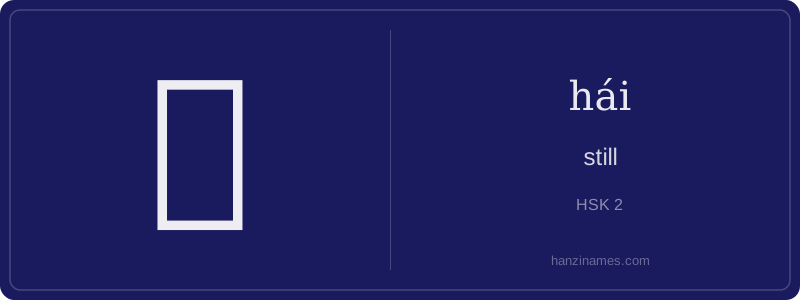
In modern Chinese daily life, 还 (hái) is indispensable for expressing contrast, continuation, or emphasis—especially in conversational markers like '还好' (hái hǎo, 'not bad / luckily') or '还是' (háishì, 'still / rather'). It appears in the HSK 2 vocabulary list and ranks among the top 50 most frequently used function words. The idiom '一而再,再而三,还...' (yī ér zài, zài ér sān, hái...) illustrates iterative persistence—documented in Ming-dynasty vernacular fiction and still used in speeches and social media.
The character’s form combines the walking radical 辶 (chuò) with 亥 (hài) as its phonetic component. Archaeological evidence from Warring States bamboo slips (c. 475–221 BCE) confirms 还 (huán) was already used for 'returning'—its shape stable for over 2,300 years. No pictographic origin exists; it’s a phono-semantic compound, not a pictograph of sun or tree.
Imagine standing at a bustling Beijing subway station during rush hour—people stream past, phones in hand, backpacks slung over shoulders. A young woman checks her watch and sighs: '还有五分钟!' (Hái yǒu wǔ fēnzhōng!)—'Only five minutes left!' Here, 还 (hái) conveys urgency and continuation: time is still ticking, the train hasn’t arrived yet, but hope remains. It’s not just grammar—it’s the rhythm of daily patience in China’s fast-paced cities.
The character 还 appears constantly in spoken Mandarin, stitching together expectation and reality. When a friend says '他还没来' (Tā hái méi lái), it doesn’t just mean 'He hasn’t come yet'—it carries gentle concern, shared waiting, maybe even mild teasing. This 'still/yet' nuance reflects a cultural comfort with suspended states: unfinished tasks, pending answers, evolving relationships—all held lightly with 还.
Its dual pronunciation tells another story: as hái, it marks temporal or logical continuity; as huán, it means 'to return'—a physical or moral restitution. In ancient texts like the *Zuo Zhuan*, 还 (huán) described feudal lords returning to court; today, students say '我还书' (Wǒ huán shū) when returning library books. That duality—stillness and return—is embedded in the character’s structure: the 'walking' radical 辶 suggests motion, while the phonetic component 亥 (hài) anchors its sound and historical use in calendrical and ritual contexts.
Example Sentences
Common Compounds
Similar Characters — Don't Mix These Up
Your First Step into Chinese Culture: Get a Chinese Name
Every journey into Chinese begins with a name. Use our free Chinese name generator to create a meaningful, personalized Chinese name that fits you perfectly.
Get My Chinese Name →