因
Character Story & Explanation
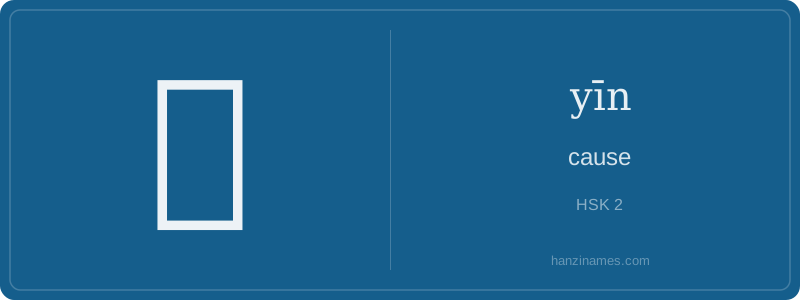
因除了 being a fundamental HSK 2 preposition meaning 'because' or 'due to', appears in countless fixed expressions like 因为 (yīn wèi, 'because') and 成因 (chéng yīn, 'etiology'). It’s indispensable in formal writing, news reports, and academic papers—e.g., government white papers cite economic shifts 因 global supply chain disruptions. The character also anchors classical idioms like 因小失大 (yīn xiǎo shī dà, 'lose the big thing because of the small'), recorded since the Warring States period.
The earliest attested form of 因 appears in late Warring States bronze inscriptions and Qin bamboo texts. It is not a pictograph but a phono-semantic compound: the outer 囗 indicates enclosure/origin, while the inner 大 (in ancient forms sometimes resembling a person lying down) suggests a foundational state. Scholars agree it evolved from a verb meaning 'to rely on' or 'to follow', later grammaticalizing into a causal preposition by the Han dynasty.
As an archaeologist brushing dust from a Han dynasty bamboo slip, I find 因 inscribed in clerical script—not as a mere preposition, but as a conceptual vessel. Its enclosing radical 囗 (wéi, 'enclosure') frames the inner component 大 (dà, 'great' or 'person'), suggesting containment of origin—like a seed held within a boundary, waiting to unfold. This spatial metaphor reflects ancient Chinese cosmology: causes are not abstract forces but bounded, tangible origins embedded in context.
Excavations at Mawangdui revealed 因 used repeatedly in medical texts to denote etiological relationships—e.g., 'cough 因 wind-cold'—showing its early grammatical role as a marker of causal linkage. Unlike Western linear causality, 因 implies interdependence: cause is inseparable from its container—time, environment, or human action. The six strokes themselves form a deliberate enclosure, each stroke a layer of contextual constraint.
Even in Tang legal documents, 因 appears in verdicts not just as 'because', but as a juridical anchor: 'the crime arose 因 poverty and famine'. Here, 因 doesn’t excuse—but locates, contextualizes, and humanizes causation. Its stability across 2,200 years reveals a cultural preference for relational logic over isolated blame. To write 因 is to trace a boundary around responsibility—and that boundary remains as vital today as it was under Emperor Wu.
Example Sentences
Common Compounds
Similar Characters — Don't Mix These Up
Your First Step into Chinese Culture: Get a Chinese Name
Every journey into Chinese begins with a name. Use our free Chinese name generator to create a meaningful, personalized Chinese name that fits you perfectly.
Get My Chinese Name →