廊
Character Story & Explanation
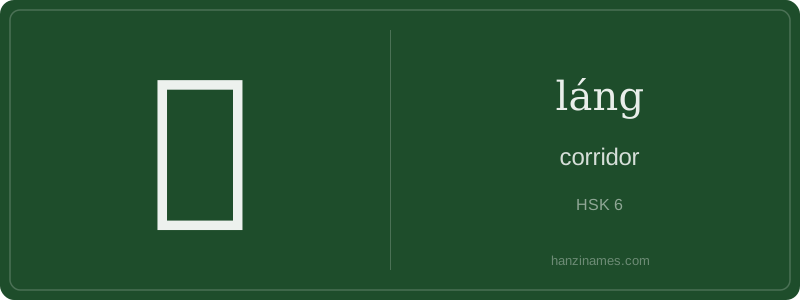
廊 is commonly used in modern Chinese to denote covered walkways—especially in schools (教学楼走廊 jiàoxué lóu zǒuláng), hospitals (住院部走廊 zhùyuàn bù zǒuláng), and historic sites like the Summer Palace’s Long Corridor (长廊 cháng láng), a UNESCO-recognized 728-meter painted gallery built in 1750. It appears in idioms like 廊庙之器 (láng miào zhī qì), meaning ‘a person fit for high office’, metaphorically linking the imperial palace corridor (symbol of governance) with talent.
The character’s form derives from the radical 广 (yǎn, ‘broad roof’ or ‘shelter’) combined with 郎 (láng, originally a title for young officials). In seal script, it clearly depicts a roofed passageway—no oracle-bone evidence survives, but bronze inscriptions from the Warring States period confirm its use for official building components.
廊 (láng) is far more than a neutral architectural term—it embodies the Chinese philosophical ideal of transitional, harmonious space. Unlike Western corridors designed for efficiency and passage, 廊 in classical Chinese gardens and courtyard homes serves as a mediating zone: between inside and outside, public and private, human and nature. Its open-sided structure invites breeze, light, and seasonal change—reflecting Daoist reverence for flow and Confucian emphasis on measured, graceful movement.
This character reveals how Chinese spatial thinking privileges relationship over separation. A 廊 does not merely connect rooms; it frames views, shelters contemplation, and choreographs social rhythm—e.g., elders strolling slowly at dusk, scholars pausing to admire plum blossoms through its latticed openings. Its presence signals intentionality: space made humane, not just functional.
Culturally, 廊 mirrors the Chinese worldview where boundaries are porous and meaning arises in liminality. It appears in poetry as a site of longing (‘walking the long corridor alone’), in painting as a compositional device guiding the eye, and in ritual architecture as a ceremonial pathway—never mere infrastructure, but a quiet conductor of qi, emotion, and cultural memory.
Example Sentences
Common Compounds
Similar Characters — Don't Mix These Up
Your First Step into Chinese Culture: Get a Chinese Name
Every journey into Chinese begins with a name. Use our free Chinese name generator to create a meaningful, personalized Chinese name that fits you perfectly.
Get My Chinese Name →