廓
Character Story & Explanation
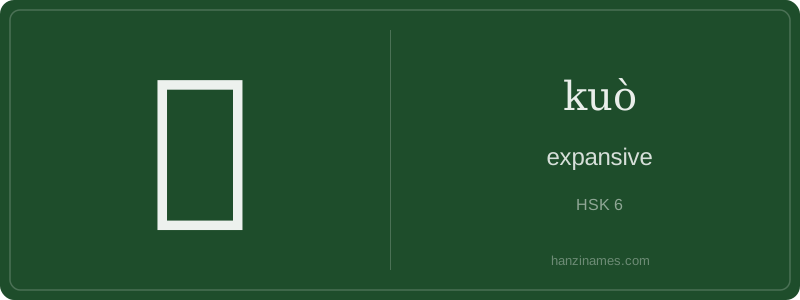
廓 is used today primarily in formal, literary, or technical contexts — especially in geography (e.g., 地形轮廓, 'terrain profile'), optics ('lens distortion correction'), and philosophy ('mental clarity'). It appears in the idiom 廓然无累 (kuò rán wú lěi), from the Zhuangzi, meaning 'serenely unburdened', describing a mind uncluttered by attachments. Historically, it was employed in Tang dynasty poetry and Song Neo-Confucian texts to denote the unobstructed moral nature.
The character is not pictographic. Its earliest attestation is in seal script (c. 3rd century BCE), combining 广 (a roof-like radical indicating space/shelter) with 郭 (guō, 'city wall') as phonetic component. Though 郭 originally meant 'outer city wall', here it serves mainly for sound — not meaning — reflecting standard phono-semantic compounding. No oracle bone or bronze inscriptions contain 廓; it emerged later as a specialized literary term.
廓 (kuò) evokes a sense of spaciousness and openness — not just physical vastness, but conceptual expansiveness: the clearing away of boundaries, the revelation of underlying structure, or the broadening of perspective. Unlike English words like 'vast' or 'extensive', which emphasize scale, 廓 carries an active, almost architectural nuance: it implies *defining* or *outlining* a space — making contours visible. This aligns with its radical 广 (guǎng), meaning 'broad' or 'veranda', suggesting sheltered openness.
In classical Chinese, 廓 appears in Daoist and philosophical texts to describe the unobstructed mind or the boundless realm of the Dao — not emptiness, but potential made manifest through clarity. Its semantic weight leans less on sheer size and more on the *act of delineation*: removing clutter to reveal inherent scope. This resonates with Western ideals like Kant’s 'unbounded sublime' or Heidegger’s 'clearing' (Lichtung), where truth emerges only when obstructions are removed.
Western equivalents often miss this dual emphasis on both spatial extent and intentional revelation. 'Expanse' suggests immensity but lacks agency; 'horizon' implies boundary yet not expansion. 廓 is closer to the Romantic notion of 'sublime openness' — think Turner’s hazy seascapes where light defines form — or the architectural concept of 'void space' in Mies van der Rohe’s work: emptiness made meaningful through precise framing. It’s not passive bigness — it’s clarity-through-definition.
Example Sentences
Common Compounds
Similar Characters — Don't Mix These Up
Your First Step into Chinese Culture: Get a Chinese Name
Every journey into Chinese begins with a name. Use our free Chinese name generator to create a meaningful, personalized Chinese name that fits you perfectly.
Get My Chinese Name →