庙
Character Story & Explanation
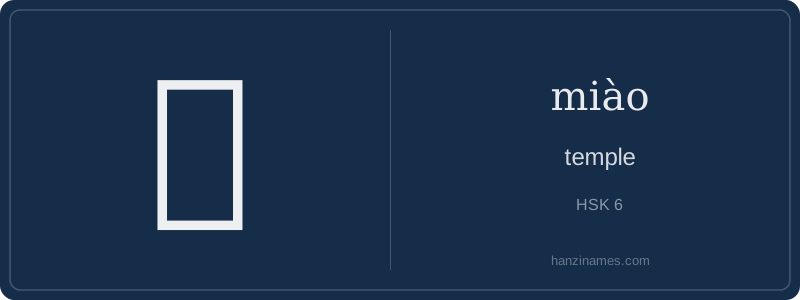
庙 appears ubiquitously in modern China: from Beijing’s Temple of Heaven (天坛, Tiāntán) — a UNESCO site used by Ming and Qing emperors for annual heaven-worship rites — to neighborhood Tudigong temples where elders burn incense before dawn. It’s central in idioms like ‘借花献佛’ (jiè huā xiàn fó, ‘borrow flowers to offer Buddha’), meaning to give a gift using someone else’s resources, reflecting temple culture’s role in social reciprocity. The character also appears in official terms like ‘庙堂’ (miàotáng, ‘court hall’), metaphorically denoting state power.
Oracle bone and bronze inscriptions show no early form of 庙; its earliest attested use is in Warring States bamboo texts, written as 廟 with the ‘roof’ radical 广 and phonetic component 朝 (cháo). By Han times, it standardized as 庙. Today, Chinese people commonly say ‘去庙里上香’ (qù miào lǐ shàng xiāng, ‘go to the temple to burn incense’) — a routine act blending folk belief, family tradition, and quiet contemplation.
The character 庙 (miào) embodies more than architectural space—it signifies a sacred threshold between human and divine, ancestor and descendant. In traditional Chinese cosmology, temples are not mere buildings but energetic nodes where qi converges, rituals stabilize cosmic order, and lineage is ritually renewed. This reflects the Confucian-Buddhist-Taoist synthesis: reverence for ancestors, veneration of deities, and alignment with natural and moral law—all housed under one roof.
Historically, 庙 was first used for ancestral shrines in Zhou dynasty rites—long before Buddhist temples arrived. The earliest ‘temples’ honored clan founders or sage-kings like Confucius, reinforcing social hierarchy through ritual geography. Even today, a village 庙 may enshrine both Guanyin and the local earth god (Tudigong), revealing China’s pragmatic, inclusive religiosity—where function, community need, and spiritual efficacy outweigh doctrinal purity.
Its radical 广 (guǎng, ‘broad shelter’) visually anchors the concept: a wide-roofed structure offering protection—not just from rain, but from chaos and moral decay. The right side 由 (yóu, ‘origin, cause’) subtly evokes intentionality: a temple arises from deliberate devotion, not accident. Thus, 庙 encodes a worldview where sacred space is ethically grounded, socially embedded, and cosmologically resonant—architecture as embodied philosophy.
Example Sentences
Common Compounds
Similar Characters — Don't Mix These Up
Your First Step into Chinese Culture: Get a Chinese Name
Every journey into Chinese begins with a name. Use our free Chinese name generator to create a meaningful, personalized Chinese name that fits you perfectly.
Get My Chinese Name →