弊
Character Story & Explanation
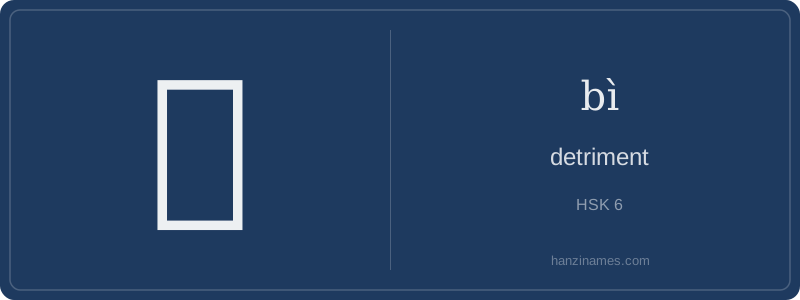
In contemporary China, 弊 is routinely used in formal writing and media to denote structural or functional drawbacks—especially in policy analysis, business reviews, and academic critiques. Common phrases include ‘弊端’ (bìduān, ‘drawback’ or ‘flaw’) and ‘营私舞弊’ (yíngsī wǔbì, ‘embezzlement and fraud’), the latter codified in China’s Criminal Law (Article 271). Government white papers on education reform and anti-corruption campaigns frequently cite ‘消除体制性弊端’ (‘eliminate systemic drawbacks’), reflecting its institutional weight.
The character’s form does not derive from a pictograph but evolved from seal script. Its top component 畀 (bì, ‘to bestow’) combines with 廾 (‘hands holding’), suggesting ‘what is improperly bestowed’—a semantic shift documented in *Shuōwén Jiězì* (121 CE). Today, Chinese students write 弊 in ethics classes while analyzing real cases like exam cheating scandals—where ‘作弊’ (zuòbì, ‘cheating’) directly uses this character.
Imagine a bustling Shanghai tech startup’s boardroom, where executives debate whether to adopt an AI-driven HR system. One veteran manager raises a hand: ‘这个方案有利有弊’ — 'This plan has both advantages and drawbacks.' Here, 弊 (bì) isn’t abstract—it’s the tangible risk of biased algorithms misclassifying candidates, or the hidden cost of retraining staff. It carries weight because in Chinese discourse, acknowledging 弊 isn’t weakness; it’s intellectual honesty and strategic foresight.
Historically, 弊 appears in classical texts like the *Zuo Zhuan*, describing political corruption—‘营私舞弊’ (embezzlement and fraud)—a usage still central today. Its radical 廾 (gǒng), meaning ‘to hold with both hands’, ironically frames the character: what is grasped carelessly—power, profit, shortcuts—often becomes the source of harm. This duality makes 弊 uniquely precise: not just ‘bad’, but ‘harm arising from misuse or flaw’.
In modern China, 弊 surfaces most powerfully in public discourse about systemic issues: educational inequality, environmental trade-offs, or digital privacy. When netizens critique a new policy, comments like ‘这个规定有明显弊端’ (‘This regulation has clear drawbacks’) signal civic engagement—not cynicism. At HSK 6, learners encounter 弊 not as vocabulary, but as a lens for understanding how Chinese speakers weigh progress against consequence, always asking: ‘What is the 弊?’
Example Sentences
Common Compounds
Similar Characters — Don't Mix These Up
Your First Step into Chinese Culture: Get a Chinese Name
Every journey into Chinese begins with a name. Use our free Chinese name generator to create a meaningful, personalized Chinese name that fits you perfectly.
Get My Chinese Name →