弦
Character Story & Explanation
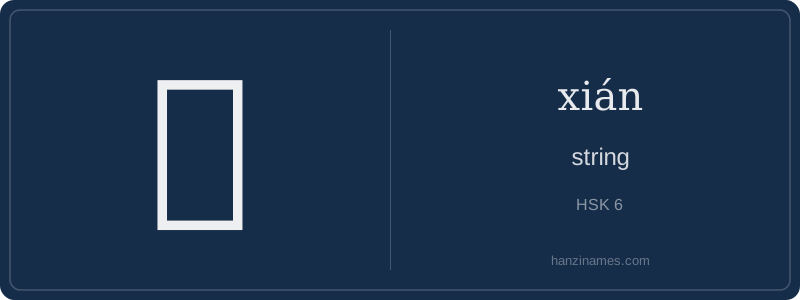
In modern Chinese, 弦 most commonly appears in musical contexts—‘string’ on instruments like the guitar (吉他弦 jítā xián) or erhu (二胡弦 èrhú xián)—and in idioms like 拨动心弦 (bō dòng xīn xián, 'to stir the heartstrings'), widely used in literature, advertising, and speeches. Historically, it appears in *The Book of Rites* (Lǐjì) describing ritual archery and in Tang poetry referencing zither strings (e.g., Bai Juyi’s 'Pipa Xing'). It also survives in technical terms like 弦长 (xián cháng, 'chord length') in geometry.
The character’s form is not pictographic but phono-semantic: 弓 (bow) is the semantic radical indicating category, while 玄 (xuán) is the phonetic component. No oracle bone or bronze script forms of 弦 survive—the earliest confirmed forms appear in Warring States bamboo manuscripts, already with this structure. Today, Chinese students learn it in HSK 6 vocabulary lists primarily via musical and mathematical usage.
As an archaeologist sifting through bamboo slips from the Warring States period, I found 弦 etched beside diagrams of composite bows—its form unmistakably a taut cord stretched across the arc of a bow (弓). The left radical 弓 anchors its identity in archery, while the right component 玄 (xuán), meaning 'profound' or 'dark', likely served phonetic function early on but also evoked the taut, resonant tension of a drawn string—both physical and metaphysical.
This character is not merely technical; it bridges martial utility and aesthetic sensibility. In excavated texts like the *Guodian Chu Slips*, 弦 appears in contexts describing ritual archery and music—where the same tension that propels an arrow also vibrates to produce tone. Its duality reflects ancient Chinese cosmology: the bow string as axis mundi—connecting earth (archer) and heaven (flight), force and harmony.
By Han dynasty bronze inscriptions and the *Shuōwén Jiězì* (121 CE), 弦 had solidified as both literal bowstring and metaphorical ‘line’ or ‘thread’—e.g., in musical strings or moral boundaries. Its evolution mirrors how early Chinese thinkers abstracted material objects into conceptual frameworks: a string becomes a principle—taut yet flexible, binding yet resonant—a perfect vessel for philosophical nuance.
Example Sentences
Common Compounds
Similar Characters — Don't Mix These Up
Your First Step into Chinese Culture: Get a Chinese Name
Every journey into Chinese begins with a name. Use our free Chinese name generator to create a meaningful, personalized Chinese name that fits you perfectly.
Get My Chinese Name →