弥
Character Story & Explanation
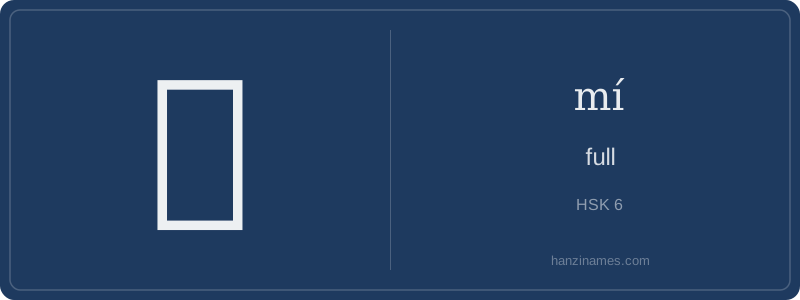
‘弥’ is commonly used in formal and literary contexts—not daily colloquial speech—but appears frequently in idioms like 弥天大谎 (mí tiān dà huǎng, 'a colossal lie'), where ‘弥’ intensifies ‘heaven-filling’, and in Buddhist terms such as 弥勒佛 (Mílè Fó, Maitreya Buddha), reflecting its association with boundlessness and future fulfillment. It also appears in modern journalistic and political language, e.g., 弥合分歧 (mí hé fēn qí, 'to bridge differences'), emphasizing reconciliation through comprehensive effort.
The character’s form combines 弓 (gōng, ‘bow’) and 尔 (ěr, archaic pronoun meaning ‘you/thus’), evolving from seal script where the bow radical conveyed extension and reach. Though not pictographic, its structure reflects semantic composition: the bow suggests stretching or spanning, while 尔 adds a sense of immediacy or totality—thus, ‘filling fully across space or time’. No oracle bone form survives; earliest attestation is in Warring States bamboo texts.
‘弥’ (mí) embodies a profound Chinese worldview where ‘fullness’ is not mere quantity, but harmonious saturation—like mist filling a valley without overflow, or compassion permeating all beings without exclusion. In Daoist and Buddhist thought, this kind of fullness implies completeness through soft, pervasive presence rather than forceful domination—a quiet suffusion that aligns with the principle of *wu wei* (effortless action).
The character evokes a relational ontology: things become ‘full’ not in isolation, but through interconnection—time fills a moment, kindness fills a gesture, truth fills a statement. This reflects the classical Chinese emphasis on context, resonance, and dynamic balance over static absolutes. ‘Full’ here is neither excess nor endpoint, but a living, breathable plenitude.
Historically, ‘弥’ appears in texts like the *Zuo Zhuan* and Buddhist sutras to describe boundless qualities—‘boundless compassion’ (慈悲弥广), ‘pervasive sincerity’ (诚意弥笃). Its philosophical weight lies in suggesting that true fullness expands outward while remaining grounded, much like a bow’s curve holding tension without breaking—a subtle nod to its ‘bow’ (弓) radical, symbolizing contained power and graceful reach.
Example Sentences
Common Compounds
Similar Characters — Don't Mix These Up
Your First Step into Chinese Culture: Get a Chinese Name
Every journey into Chinese begins with a name. Use our free Chinese name generator to create a meaningful, personalized Chinese name that fits you perfectly.
Get My Chinese Name →