彰
Character Story & Explanation
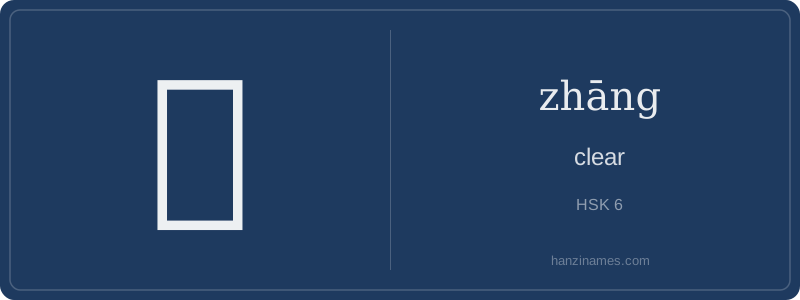
彰 is predominantly used in formal, written Chinese—not daily speech—appearing in official documents, academic writing, and classical allusions. It’s central to the idiom 彰善瘅恶 (zhāng shàn dàn è), meaning 'to praise virtue and condemn vice,' codified in Confucian historiography since the *Zuo Zhuan*. Modern usage includes government reports (e.g., '政策效果显著彰顯' — 'policy effects are strikingly evident') and news headlines about transparent governance.
The character’s form has no oracle-bone or bronze script attestation; it first appears in seal script (c. 3rd c. BCE). Its structure is phono-semantic: 彡 (radical, hinting at ornamentation/clarity) + 章 (phonetic and semantic component, meaning 'chapter' or 'pattern'). Historically, it functioned as a verb meaning 'to make clear' or 'to highlight'—still its core usage today.
As an archaeologist brushing dust from a Han dynasty bamboo slip, I uncovered 彰 not as a static glyph, but as a dynamic verb of revelation—its 彡 (shān) radical, the 'ornamental strokes', evoking the shimmering clarity of light catching embroidered silk. This wasn’t mere visibility; it was *intentional manifestation*, like a magistrate publicly posting decrees to make justice unmistakable. The right side, 章 (zhāng), originally meant 'a complete, well-structured pattern'—think of ritual music scores or embroidered insignia—signifying order made legible.
Excavations at Mawangdui revealed 彰 used in medical texts (e.g., *Wushi'er Bingfang*) to denote symptoms that ‘clearly appear’—not just visible, but diagnostically unambiguous. Unlike generic ‘see’ characters, 彰 implies authoritative disclosure: when a truth is 彰, it carries weight, evidence, and social recognition. Its 14 strokes form a deliberate architecture—three decorative strokes on the left anchoring a complex, rule-governed structure on the right.
This character resisted simplification in the 20th century, preserving its classical integrity—a rarity among HSK 6 characters. Its endurance signals cultural reverence for clarity as moral and administrative virtue. In Tang steles, 彰 appears in epitaphs praising officials who ‘made virtue manifest’ (彰德), transforming abstract ethics into public record. Even today, its use in legal and academic contexts retains this ancient gravity: clarity isn’t passive—it’s enacted, witnessed, and inscribed.
Example Sentences
Common Compounds
Similar Characters — Don't Mix These Up
Your First Step into Chinese Culture: Get a Chinese Name
Every journey into Chinese begins with a name. Use our free Chinese name generator to create a meaningful, personalized Chinese name that fits you perfectly.
Get My Chinese Name →