恒
Character Story & Explanation
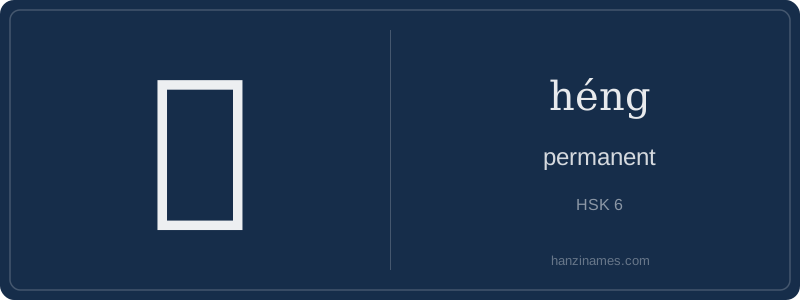
恒 is widely used in modern Standard Chinese across formal and everyday contexts: in idioms like 持之以恒 (chí zhī yǐ héng, 'persist with constancy'), in scientific terms like 恒星 (héngxīng, 'star'—literally 'permanent star', reflecting pre-telescopic observation of fixed stellar positions), and in brand names (e.g., HengAn Group, a major Chinese hygiene company, evoking trustworthiness). It appears in the 1912 Republic of China Constitution and remains in contemporary legal and educational discourse to denote enduring principles.
The character evolved from seal script, where its right side 可 (kě) served phonetically, while the left 忄 (heart-mind radical) semantically anchored it in human disposition. No oracle bone form survives, but bronze inscriptions from the Warring States period (475–221 BCE) show early variants confirming its association with steadfastness in moral conduct.
The character 恒 (héng) embodies a profound Chinese philosophical ideal: constancy not as rigid immutability, but as enduring integrity amid change. Rooted in the heart-mind radical 忄, it signals that permanence is an inner, moral stance—like the unwavering commitment of a sage or the steady rhythm of cosmic patterns (e.g., the ‘eternal’ cycles of yin-yang). This reflects the Confucian-Buddhist-Taoist convergence where true endurance arises from ethical consistency, not external stasis.
In classical thought, 恒 appears in foundational texts like the *Yijing* (I Ching), where ‘恒’ is Hexagram 32—symbolizing lasting virtue through perseverance and alignment with natural law. Unlike Western notions of permanence tied to material fixity, 恒 emphasizes continuity of intention, practice, and relationship—such as lifelong filial devotion or the unbroken transmission of ritual knowledge across generations.
This worldview shapes modern usage: 恒 implies reliability grounded in character, not just duration. A ‘恒心’ (hèngxīn) isn’t mere stubbornness—it’s disciplined resolve cultivated daily; a ‘恒星’ (héngxīng, ‘fixed star’) evokes celestial stability that ancient astronomers used to calibrate time and ethics alike. Thus, 恒 reveals how Chinese culture locates permanence not in objects, but in the harmonious, repeated enactment of virtue.
Example Sentences
Common Compounds
Similar Characters — Don't Mix These Up
Your First Step into Chinese Culture: Get a Chinese Name
Every journey into Chinese begins with a name. Use our free Chinese name generator to create a meaningful, personalized Chinese name that fits you perfectly.
Get My Chinese Name →