恍
Character Story & Explanation
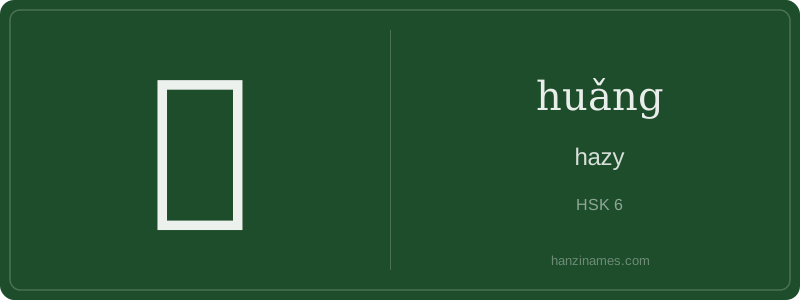
恍 is most famously used in the idiom 恍然大悟 (huǎng rán dà wù), meaning 'sudden enlightenment' or 'a flash of realization' — a cornerstone phrase in classical and modern Chinese literature, education, and daily speech. It appears in Ming-Qing vernacular novels like Journey to the West and remains common in HSK-6-level textbooks and news commentary. The character also frequently occurs in literary descriptions of memory, dreams, and emotional disorientation, especially in 20th-century writers like Lu Xun and Eileen Chang.
Graphically, 恍 is a phono-semantic compound: the left 忄 (heart-mind radical) signals its psychological domain, while the right 光 (guāng, 'light') provides phonetic approximation (huǎng and guāng share historical sound connections in Middle Chinese). Though not a pictograph, its structure reflects how Chinese script links inner states with sensory metaphors — here, light that flickers, glints, or fails to fully illuminate.
The character 恍 (huǎng) embodies a uniquely Chinese philosophical sensitivity to the liminal space between perception and reality — not confusion, but a gentle, almost poetic suspension of clarity. Rooted in the heart-mind radical 忄, it signals an internal, affective state rather than external disorder. This reflects the classical Daoist and Chan Buddhist appreciation for impermanence and the veil of illusion (幻, huàn), where ‘haziness’ isn’t failure of cognition but a threshold of insight.
In traditional Chinese thought, mental haziness is rarely pathologized; instead, 恍 often appears in meditative or aesthetic contexts — like the ‘flickering awareness’ before enlightenment or the dreamlike resonance in Tang poetry. It carries quiet reverence: to be 恍 is to stand at the edge of understanding, where certainty softens and intuition deepens. This mirrors the Confucian ideal of ‘knowing what one does not know’ — humility as intellectual virtue.
Culturally, 恍 reveals how Chinese language maps interiority with subtle precision: unlike English’s blunt ‘dazed’ or ‘confused’, 恍 implies transience, lightness, and even grace. It appears in phrases describing sudden recollection (恍然大悟) — where the ‘haze’ lifts *because* it was there to begin with. This suggests a worldview where clarity emerges not from forceful analysis, but from patient, embodied presence — a quiet mind letting truth surface like mist parting at dawn.
Example Sentences
Common Compounds
Similar Characters — Don't Mix These Up
Your First Step into Chinese Culture: Get a Chinese Name
Every journey into Chinese begins with a name. Use our free Chinese name generator to create a meaningful, personalized Chinese name that fits you perfectly.
Get My Chinese Name →