恕
Character Story & Explanation
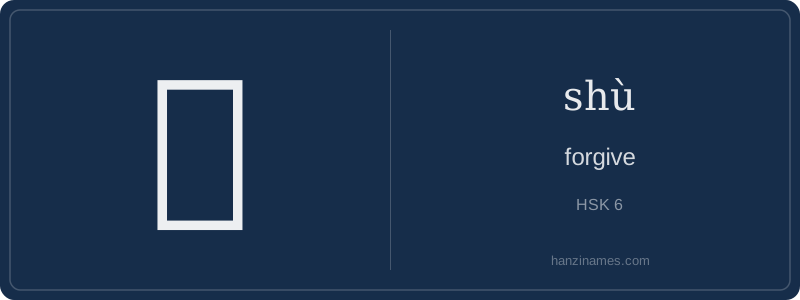
In contemporary China, 恕 appears most commonly in formal, written contexts: official apologies, academic ethics statements, and classical literature study. It’s central to the Confucian phrase 己所不欲,勿施于人 (jǐ suǒ bù yù, wù shī yú rén), known as the 'Silver Rule' — cited in state-run textbooks (Ministry of Education, 2022 Curriculum Standards) and featured in HSK 6 reading passages. The character also appears in legal commentary on 'leniency with reason' (宽恕, kuānshù).
The character’s form combines the 心 (xīn) radical at the bottom — indicating its emotional-cognitive nature — and the top component 如 (rú), meaning 'as if' or 'like'. As documented in the Shuōwén Jiězì (c. 100 CE), this structure reflects the idea of 'feeling as if one were in another’s place', not a pictographic origin but a semantic compound grounded in early Han lexicography.
At the heart of Confucian ethics, 恕 (shù) is far more than 'to forgive' — it’s the empathetic principle of 'do not impose on others what you do not desire for yourself' (《论语》, Analects 15.24). This 'reciprocal empathy' forms the moral bedrock of interpersonal harmony in Chinese society, guiding everything from family disputes to workplace mediation.
Unlike passive forgiveness, 恕 implies active moral imagination: seeing oneself in another’s position before judgment. Its 心 (heart/mind) radical signals this internal, reflective process — not just pardoning an offense, but first understanding its human cause. This distinguishes it from legal absolution or ritual apology.
In modern China, 恕 remains deeply embedded in ethical discourse, especially in education and law reform. Teachers cite it when discussing restorative justice; judges reference it in sentencing remarks emphasizing rehabilitation over retribution. Though rarely used alone in speech, it thrives in set phrases like 恕不奉陪 (‘I beg your pardon — I must decline’) — a polite, culturally coded exit that preserves face for all parties.
Example Sentences
Common Compounds
Similar Characters — Don't Mix These Up
Your First Step into Chinese Culture: Get a Chinese Name
Every journey into Chinese begins with a name. Use our free Chinese name generator to create a meaningful, personalized Chinese name that fits you perfectly.
Get My Chinese Name →