耻
Character Story & Explanation
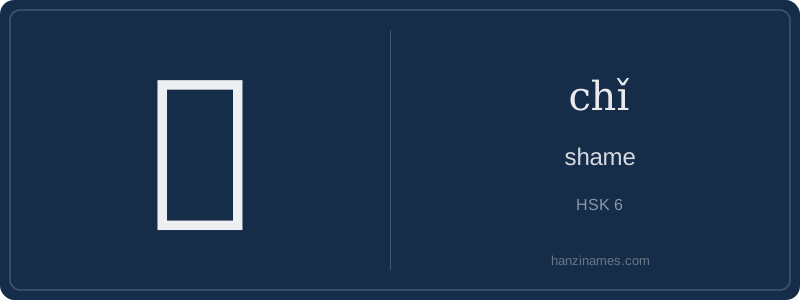
耻 is widely used in modern Chinese public discourse — for example, government anti-corruption campaigns frequently invoke ‘知耻’ (zhī chǐ, ‘knowing shame’) as a virtue for officials. The idiom ‘不知羞耻’ (bù zhī xiū chǐ, ‘not knowing shame’) appears in official media to condemn unethical behavior. Historically, Mencius wrote, ‘无羞恶之心,非人也’ (‘One without a sense of shame and disgust is not human’), cementing its philosophical centrality.
The character’s earliest attested form appears in bronze inscriptions (c. 1000 BCE), showing ear + stop components — not a pictograph, but a semantic compound. Scholars agree the ear radical reflects social accountability: shame arises when one hears how others judge one’s actions. No oracle-bone version survives, but its structure has remained stable for over 2,500 years.
Hi students! Today we’re learning 耻 (chǐ), meaning 'shame' or 'disgrace'. It’s an emotionally weighty character — not just about feeling embarrassed, but about violating social or moral expectations. In Chinese culture, shame is deeply tied to reputation, family honor, and self-cultivation. Think of it as a moral compass: when someone acts unethically, they ‘bring shame’ (丢脸 or 有辱) — and that inner discomfort is 耻. It’s used in formal speech, writing, and moral education — not casual chit-chat.
This character appears in classical texts like the Analects of Confucius, where he says, ‘The gentleman understands righteousness; the petty person understands profit’ — and implicitly, the gentleman feels 耻 at wrongdoing. At HSK Level 6, you’ll encounter it in essays, news reports on ethics, and discussions of integrity. Don’t confuse it with simple embarrassment (e.g., 尴尬 gāngà); 耻 carries gravity — it’s about conscience, not just awkwardness.
Notice its radical: 耳 (ear). Why? Historically, the ear symbolized ‘hearing criticism’ or ‘being called out’ — a public or internal rebuke that triggers shame. The right side, 止 (zhǐ), means ‘to stop’ — suggesting shame halts improper action. So 耻 visually conveys: ‘Hearing reproach stops you from doing wrong.’ That’s why it’s central to Confucian self-reflection. When you see it, think of moral pause — not just blushing, but choosing better.
Example Sentences
Common Compounds
Similar Characters — Don't Mix These Up
Your First Step into Chinese Culture: Get a Chinese Name
Every journey into Chinese begins with a name. Use our free Chinese name generator to create a meaningful, personalized Chinese name that fits you perfectly.
Get My Chinese Name →