恰
Character Story & Explanation
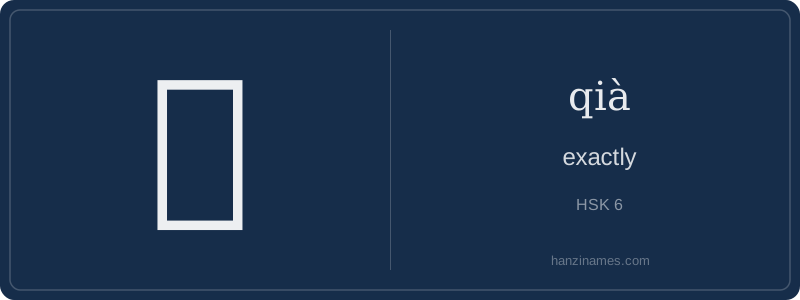
恰 is commonly used in modern Mandarin in phrases like 恰好 (qiàhǎo, 'just in time'), 恰当 (qiàdàng, 'appropriate'), and 恰如其分 (qiàrúqífèn, 'exactly fitting, to the point'). It appears frequently in formal writing, journalism, and spoken explanations where precision matters—e.g., news reports noting a policy was implemented '恰在经济复苏初期' ('exactly at the early stage of economic recovery'). The phrase 恰到好处 (qià dào hǎo chù) — 'just right', literally 'arriving at the good place' — is a widely recognized idiom dating back to Qing dynasty literary criticism, describing aesthetic balance.
The character evolved from the ancient form 洽 (qià), originally meaning 'to moisten thoroughly' or 'to harmonize', with 忄 (heart/mind radical) added later to emphasize subjective judgment. Its current form (with 忄 + 合) reflects its semantic shift: combining 'heart/mind' and 'to unite/fit' — signifying mental recognition of perfect fit. No oracle bone or bronze script forms survive; earliest attestations appear in Han dynasty texts as a variant of 洽.
The Chinese character 恰 (qià) conveys precision—'exactly', 'just right', or 'precisely at that moment'. Unlike English adverbs like 'exactly', which often emphasize numerical or logical accuracy, 恰 carries a subtle emotional or contextual nuance: it suggests harmony between timing, degree, and appropriateness. It’s rarely used alone but functions as a delicate modifier, fine-tuning verbs or adjectives to signal ideal alignment—e.g., 恰好 (qiàhǎo) meaning 'just in time' or 'coincidentally perfect'.
This nuance resonates with Western philosophical ideals like Aristotle’s 'golden mean'—the virtue of balance—but operates more pragmatically in daily speech. While English might say 'That’s *exactly* what I meant!', Chinese uses 恰 to imply the idea was not only correct but *ideally timed or proportioned*. It reflects a cultural preference for contextual fit over absolute correctness—less about rigid truth, more about relational appropriateness.
In cross-cultural communication, mistaking 恰 for a simple synonym of 'exactly' can lead to overstatement. Where English speakers might emphasize factual identity ('This is exactly the same'), 恰 leans toward situational congruence ('This fits *just so*'). Its usage mirrors Confucian ideals of *zhongyong* (the Doctrine of the Mean), valuing measured, context-sensitive responses over blunt equivalence—making it a quiet marker of linguistic and cultural sophistication at HSK Level 6.
Example Sentences
Common Compounds
Similar Characters — Don't Mix These Up
Your First Step into Chinese Culture: Get a Chinese Name
Every journey into Chinese begins with a name. Use our free Chinese name generator to create a meaningful, personalized Chinese name that fits you perfectly.
Get My Chinese Name →