悟
Character Story & Explanation
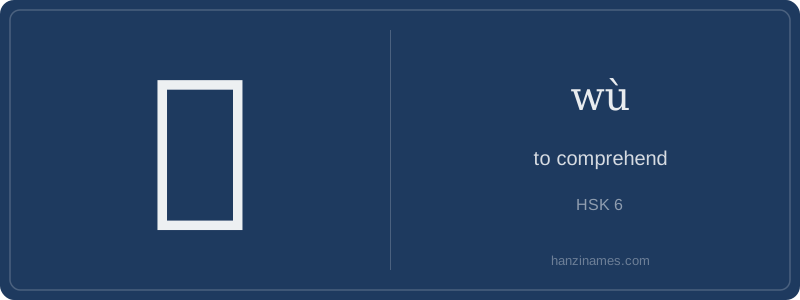
悟 is central to Chinese literary, philosophical, and religious life. It appears in the title of the classic novel Journey to the West (《西游记》), where the Monkey King is named Sun Wukong—‘Wu’ meaning ‘awakened’ or ‘enlightened,’ directly referencing profound comprehension. Common idioms include 恍然大悟 (huǎngrán dàwù, ‘suddenly comprehend fully’) and 大彻大悟 (dà chè dà wù, ‘thoroughly awaken’), both used in modern speech to describe pivotal realizations. Historically, Tang and Song dynasty Chan (Zen) Buddhist records document monks attaining 悟 after years of meditation and dialogue with masters.
The character evolved from seal script (c. 3rd century BCE), combining 忄 (heart/mind radical) and 吾 (wú, ‘I’ or ‘myself’), indicating introspective realization—not external instruction. No oracle-bone form survives, but by the Han dynasty, 悟 was firmly established in philosophical texts like the Huainanzi to denote insight gained through contemplation. Today, Chinese students write 悟 in essays on literature or ethics, teachers praise ‘a student’s deep 悟性 (wùxìng, “capacity for insight”), and tech startups use it in slogans like ‘悟变未来’ (‘Awaken change for the future’).
悟 (wù) embodies a distinctly Chinese epistemology—one where understanding is not merely intellectual acquisition but a sudden, intuitive breakthrough born of reflection, experience, and inner stillness. Unlike Western notions of 'learning' as accumulation, 悟 implies a moment of resonance: the mind aligning with truth already present in the world or self. This reflects Daoist and Chan Buddhist ideals—truth is not imposed but uncovered, like mist lifting from a mountain.
In classical Chinese thought, 悟 is inseparable from moral cultivation. Confucius spoke of ‘knowing what one does not know’ (《论语》), while Chan masters used paradoxical riddles (gōng’ān) to shatter logical thinking and provoke 悟. It’s never passive reception; it demands humility, patience, and embodied practice—whether calligraphy, tea ceremony, or martial arts—where repetition prepares the ground for insight.
The character itself—heart-mind radical (忄) plus ‘I’ (吾)—suggests comprehension arising from self-awareness. This mirrors the Confucian ideal of ‘extending one’s innate moral knowing’ (推己及人). To 悟 is thus both personal and relational: true understanding transforms how one sees others and acts in the world. It’s why 悟 appears in texts on strategy (e.g., Sun Tzu’s Art of War commentaries), medicine (TCM diagnosis), and poetry—not as abstract theory, but lived wisdom.
Example Sentences
Common Compounds
Similar Characters — Don't Mix These Up
Your First Step into Chinese Culture: Get a Chinese Name
Every journey into Chinese begins with a name. Use our free Chinese name generator to create a meaningful, personalized Chinese name that fits you perfectly.
Get My Chinese Name →