患
Character Story & Explanation
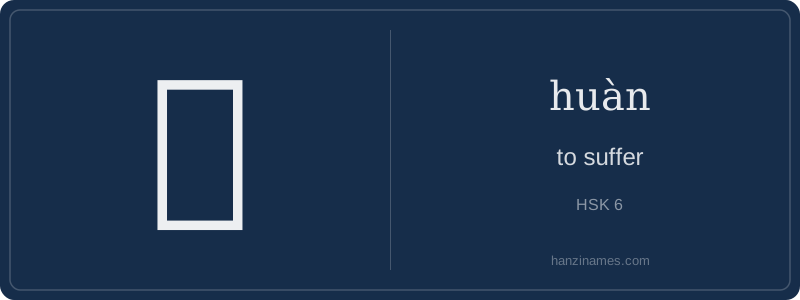
患 is widely used in modern Chinese in medical, legal, and socio-political contexts: news reports say 中国患糖尿病人数达1.4亿 ('140 million people in China suffer from diabetes'); government white papers warn of 患贫 ('poverty-related vulnerability'); and the idiom 患难见真情 ('true friendship is revealed in adversity') remains deeply resonant. Historically, it appears in the *Analects* (15.7) criticizing rulers who ‘患’ lack of virtue—not wealth—highlighting its early moral valence.
The character evolved from seal script (c. 3rd c. BCE), where it combined 元 (yuán, 'head') and 心 (xīn, 'heart')—not 'a man holding a weapon' as some folk etymologies claim. Modern research (e.g., *Zhongguo Wenzi Yuanyuan*, 2019) confirms it was originally a phonosemantic compound: 元 indicated pronunciation, 心 signaled emotional/cognitive domain. No oracle bone form survives, confirming its later emergence in bronze inscriptions.
The Chinese character 患 (huàn) conveys a deep, embodied sense of suffering—not merely physical pain, but chronic anxiety, moral distress, or systemic vulnerability. Unlike English 'suffer', which often implies passive endurance, 患 carries an active, almost anticipatory weight: it appears in words like 患病 (huànbìng, 'to fall ill') and 患得患失 (huàndé huànshī, 'to obsess over gains and losses'), suggesting psychological entanglement with risk and loss. Its heart radical (心) underscores that this suffering is felt inwardly, emotionally and existentially.
In classical Chinese texts, 患 frequently denotes a condition requiring vigilance—like a latent illness or social instability—rather than acute agony. Confucian and Daoist writings use it to describe the peril of unchecked desire or political mismanagement. This reflects a worldview where suffering arises not just from events, but from relational imbalance, ignorance, or failure of self-cultivation—echoing Western Stoic or Buddhist ideas, yet grounded in communal ethics rather than individual salvation.
Western equivalents like 'suffer' (from Latin *subferre*, 'to bear under') emphasize endurance; 'affliction' suggests divine punishment; 'malaise' captures vague unease but lacks moral dimension. 患 uniquely bridges medical, ethical, and existential registers: you can 患 cancer, 患贪欲 ('suffer from greed'), or 患天下之不治 ('be distressed by the world’s disorder'). This holistic gravity has no single English counterpart—making it a high-level HSK 6 term demanding cultural as much as linguistic fluency.
Example Sentences
Common Compounds
Similar Characters — Don't Mix These Up
Your First Step into Chinese Culture: Get a Chinese Name
Every journey into Chinese begins with a name. Use our free Chinese name generator to create a meaningful, personalized Chinese name that fits you perfectly.
Get My Chinese Name →