闷
Character Story & Explanation
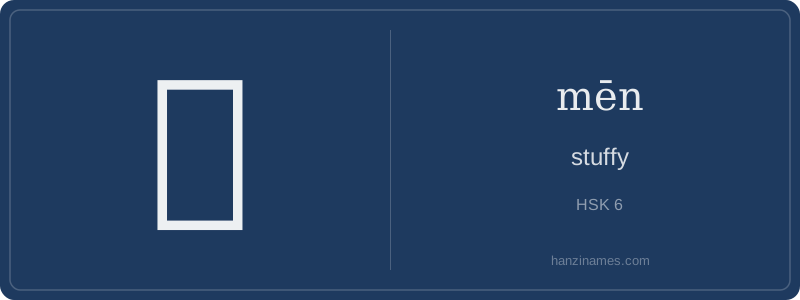
闷 is widely used in modern Mandarin, especially in weather reports, health advisories, and psychological discourse. The phrase 心里发闷 ('xīn lǐ fā mēn') — 'feeling chest-tight and low-spirited' — appears in medical literature and everyday conversation as a colloquial descriptor of anxiety or mild depression. It also appears in idioms like 闷声大发财 ('mèn shēng dà fā cái'), meaning 'to grow wealthy quietly without drawing attention', reflecting cultural values of modesty and discretion.
The character evolved from seal script where 门 (door) enclosed 耳 (ear), suggesting 'silence behind closed doors'. In modern standard form, the inner component is simplified to a dot and horizontal stroke (丶+一), retaining the 'enclosed, suppressed' semantic idea. No oracle-bone evidence exists for this specific form — its documented origin lies in Han dynasty clerical script as a phonosemantic compound.
Hi there! Let’s explore the character 闷 (mēn/mèn). At its core, it expresses physical or emotional 'stuffy' sensations — like a hot, airless room or feeling emotionally weighed down. It’s a door (门) enclosing an inner element (心 or 耳 in older forms, now simplified to ‘丶+一+冂’), symbolizing something trapped inside — heat, silence, or mood. Though simple (just 7 strokes), it carries rich nuance: context decides whether it’s about weather, psychology, or even cooking!
The two pronunciations matter: mēn is used for physical stuffiness (e.g., hot, humid weather), while mèn describes mental states — boredom, depression, or quiet introspection. This tone-based meaning split is common in Chinese and helps you sound natural. Don’t worry — native speakers often clarify with context, like adding 天气 (weather) or 心情 (mood) — so you’ll rarely be misunderstood.
As an HSK Level 6 character, 闷 appears in advanced vocabulary but is also frequently heard in daily speech — from complaining about summer heat (今天好闷!) to describing someone as ‘quiet and reserved’ (他性格很闷). Its simplicity masks its versatility: it can be an adjective, verb, or even part of compound verbs like 闷死 (to suffocate) or 闷葫芦 (a tight-lipped person). Mastering 闷 helps you express subtle feelings that English often needs whole phrases to convey.
Example Sentences
Common Compounds
Similar Characters — Don't Mix These Up
Your First Step into Chinese Culture: Get a Chinese Name
Every journey into Chinese begins with a name. Use our free Chinese name generator to create a meaningful, personalized Chinese name that fits you perfectly.
Get My Chinese Name →