愈
Character Story & Explanation
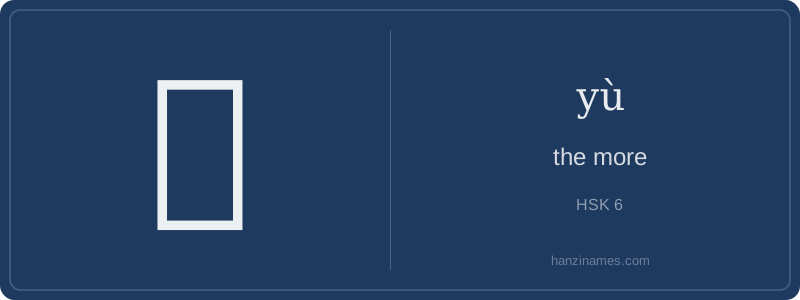
In modern Standard Chinese, 愈 appears almost exclusively in formal written contexts—academic papers, legal documents, literary prose—and nearly always in the correlative construction 愈…愈… ('the more… the more…'). It is rare in speech, where speakers prefer 越…越… (yuè… yuè…), though both convey identical meaning. Common idioms include 愈演愈烈 (yù yǎn yù liè, 'escalating increasingly')—frequently used in news reports about conflicts or crises—and 愈来愈好 (yù lái yù hǎo, 'getting better and better'), a set phrase in congratulatory messages.
The character’s form evolved from seal script (c. 3rd c. BCE), where 俞 (yú, 'to pass through; to agree') served as phonetic component and 心 as semantic indicator. No oracle bone or bronze inscriptions contain 愈; its earliest confirmed appearance is in the *Shuōwén Jiězì* (121 CE), which defines it as 'to heal'—already reflecting its later semantic shift. Today, Chinese students encounter it first in HSK 6 grammar drills focused on comparative structures.
As an archaeologist sifting through layers of linguistic sediment, I uncover 愈 not as a static glyph but as a semantic stratum revealing ancient Chinese logic of intensification. Its earliest attested uses in Warring States bamboo texts and Han dynasty commentaries show it functioning not as a verb meaning 'to heal' (a later semantic extension), but as a correlative adverb—always paired with another clause—to express proportional escalation: 'the more X, the more Y.' This syntactic fossil predates its medical sense by centuries.
The heart radical (心) is no mere decorative flourish—it anchors 愈 in the realm of subjective experience and internal state. Unlike characters for physical increase (e.g., 增), 愈 signals intensification *within perception or condition*: not 'more rice,' but 'more anxious,' 'more certain,' 'more grievous.' Its thirteen strokes form a deliberate asymmetry—five on the left (俞, a phonetic component meaning 'to pass through'), eight on the right (心)—mirroring how psychological states deepen incrementally, not linearly.
Crucially, 愈 was never used alone in classical texts. It always appeared in the fixed binomial structure 愈…愈… (yù… yù…), a grammatical fossil preserved intact from the *Zuo Zhuan* (4th c. BCE) to modern formal writing. This rigid frame reveals how early Chinese thinkers conceptualized causality and correlation—not as cause-effect chains, but as co-arising intensities. To excavate 愈 is to unearth a cognitive architecture where emotion, judgment, and consequence amplify in tandem.
Example Sentences
Common Compounds
Similar Characters — Don't Mix These Up
Your First Step into Chinese Culture: Get a Chinese Name
Every journey into Chinese begins with a name. Use our free Chinese name generator to create a meaningful, personalized Chinese name that fits you perfectly.
Get My Chinese Name →