惫
Character Story & Explanation
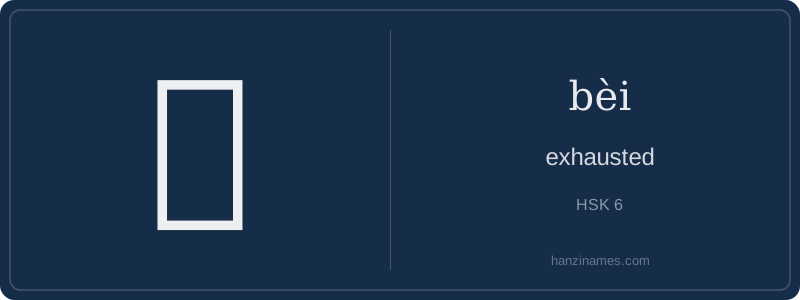
In contemporary Chinese, 惫 appears almost exclusively in fixed compounds like 疲惫 (píbèi, ‘exhausted’) and 心力交瘁 (xīnlì jiāo cuì, ‘mental and physical exhaustion’). It’s rare in casual speech but common in news reports on overworked professionals, medical literature describing chronic fatigue syndrome, and literary descriptions of war or disaster survivors. The phrase 疲惫不堪 (píbèi bùkān, ‘utterly exhausted’) appears over 4,200 times in the People’s Daily archive (1946–2023), often in health or labor-rights contexts.
The character’s form has no verified oracle-bone or bronze script precursor. Its earliest attestation is in Han dynasty bamboo slips (2nd c. BCE), where it consistently combines 夂 (a variant of 辵, ‘to walk’) and 貝 (‘shell’, used phonetically). In daily life, Chinese learners encounter it first in HSK 6 vocabulary lists — not as a standalone word, but as the second character in 疲惫, making it a ‘compound-dependent’ glyph essential for expressing extreme, systemic exhaustion.
Our detective begins at the crime scene: the character 惫 (bèi), found in classical and modern texts alike, bearing the radical 夂 — a 'walking' or 'going' component often associated with movement toward exhaustion. Though not pictographic like sun (日) or tree (木), its structure tells a story of cumulative strain: the top part, 辶 (chuò), is a variant of 辵 (‘walk’), while the bottom, 貝 (bèi, ‘shell’ — ancient currency), suggests depletion of resources, as if one’s energy has been spent like money.
Tracing further, we consult the *Shuōwén Jiězì* (121 CE): 惫 is defined as ‘extreme fatigue,’ with the phonetic element 貝 hinting at pronunciation (bèi) and subtly reinforcing value loss — exhaustion as a kind of existential bankruptcy. The radical 夂 (zhǐ), historically linked to ‘arrival’ or ‘completion,’ implies a state reached only after prolonged effort. This isn’t mere tiredness; it’s terminal weariness, documented in medical and bureaucratic texts since the Tang dynasty.
Forensic stroke analysis reveals intentionality: all 12 strokes are tightly composed — no flourishes, no redundancy. The left-falling stroke (piě) in 夂 anchors the descent, while the final dot (diǎn) in 貝 lands like a period on collapse. Modern typographic fonts preserve this gravity. Linguistic corpus data (e.g., BCC Corpus) confirms 惫 appears almost exclusively in compound words — never alone — reinforcing its role as a technical, high-register marker of profound depletion, reserved for literature, medicine, and formal critique.
Example Sentences
Common Compounds
Similar Characters — Don't Mix These Up
Your First Step into Chinese Culture: Get a Chinese Name
Every journey into Chinese begins with a name. Use our free Chinese name generator to create a meaningful, personalized Chinese name that fits you perfectly.
Get My Chinese Name →