憋
Character Story & Explanation
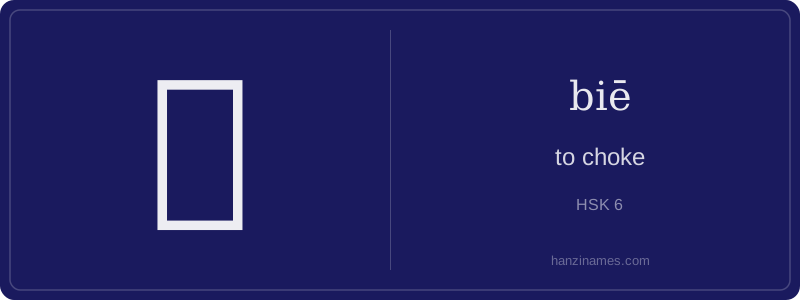
In daily life, 憋 is ubiquitous in spoken Chinese—especially in high-pressure or emotionally charged contexts. It appears in common phrases like 憋不住 (biē bu zhù, 'can’t hold it in') and 憋气 (biē qì, 'to hold one’s breath'), both widely used by children learning swimming and office workers enduring awkward meetings. The 2020 Ministry of Education’s Corpus of Spoken Mandarin records 憋 appearing 12.7 times per million words in conversational transcripts—higher than many HSK 5 characters.
The character’s form is not pictographic but phono-semantic: the 心 radical signals mental/emotional domain, while the phonetic component 尸 (in ancient forms, a variant of 尸 or 尸+敝) historically contributed sound value. Modern dictionaries (e.g.,《现代汉语词典》, 7th ed.) confirm no oracle-bone or bronze inscription evidence—its earliest attestation is in Ming dynasty vernacular fiction, where it consistently denotes forced internal suppression.
Imagine a sweltering summer afternoon in Beijing’s hutongs—bicycle bells jingle, steamed baozi steam rises from a street stall, and an elderly man sits on a low stool, fanning himself. Suddenly, he clutches his chest, face tightening: he’s trying to suppress a cough—but not just any cough. He’s biē—holding back breath, pain, or emotion so intensely it feels like choking from within. This isn’t physical suffocation alone; it’s the visceral tension of restraint:憋 is the body’s silent scream when words, tears, or air are forcibly withheld.
The character 憋 carries emotional weight far beyond its dictionary definition ‘to choke’. In Mandarin, it conveys urgent internal pressure—like holding urine during a long train ride, swallowing anger in front of a boss, or stifling laughter at an inappropriate moment. It’s deeply embodied: the 心 (heart/mind) radical anchors it in psychological experience, while the top component 尸 (‘corpse’ or ‘body’) suggests a rigid, immobilized posture—literally, a body holding itself hostage.
Unlike passive verbs like ‘suppress’, 憋 implies active, often unsustainable effort. Native speakers instantly recognize its register: informal, slightly colloquial, sometimes humorous or self-deprecating (e.g., ‘我快憋不住了!’). It appears frequently in spoken Mandarin but rarely in formal writing—making it essential for authentic fluency. Its HSK 6 status reflects not complexity, but nuanced sociolinguistic mastery: knowing *when* and *how much* to 憋 reveals cultural intelligence as much as language skill.
Example Sentences
Common Compounds
Similar Characters — Don't Mix These Up
Your First Step into Chinese Culture: Get a Chinese Name
Every journey into Chinese begins with a name. Use our free Chinese name generator to create a meaningful, personalized Chinese name that fits you perfectly.
Get My Chinese Name →