扒
Character Story & Explanation
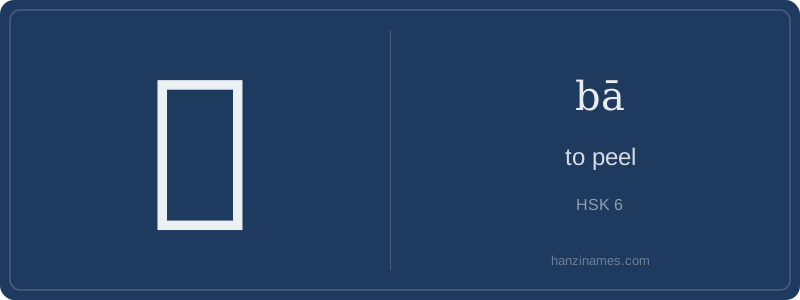
In daily life, 扒 is most commonly heard in culinary contexts: chefs say bā xiā (peel shrimp) on cooking shows, home cooks mutter bā huāshēng (peel peanuts) while watching TV, and street vendors shout 新鲜扒好的栗子! (freshly peeled chestnuts!). The HSK 6-level compound 扒窃 (bā qiè, 'pickpocketing') — literally 'peel-and-steal' — is widely used in police reports and news, reflecting the stealthy, finger-based nature of the crime.
The character is not pictographic but phono-semantic: 扌 (hand) + 八 (bā, both sound hint and semantic cue for 'separation'). Its earliest attested use dates to the Tang dynasty in medical texts describing skin removal during surgery — confirmed in the Wai Tai Mi Yao (752 CE). No oracle-bone form exists; it emerged later as a specialized character for manual extraction.
Imagine a bustling morning market in Chengdu, where steam rises from bamboo baskets of freshly boiled peanuts. A vendor deftly uses her thumb and forefinger to peel the wrinkled shells — a swift, rhythmic motion: 扒 (bā). This character captures that precise, manual act of stripping away outer layers — whether peanut skins, shrimp shells, or even stubborn stickers. Its hand radical (扌) signals physical action, while the right component (八) hints at separation — two parts pulled apart.
Though often glossed as 'to peel', 扒 carries nuanced force: it implies effort, dexterity, and sometimes urgency. In cooking, it’s indispensable — 扒虾 (bā xiā, peeling shrimp) is a standard prep step across coastal kitchens. In dialects like Shanghainese, 扒 also means 'to scrape' or 'to dig out', reflecting its tactile, grounded origin in manual labor rather than abstract thought.
The dual pronunciation reflects semantic divergence: bā dominates in standard Mandarin for peeling and prying; pá appears in literary or regional contexts, notably in the classical compound 扒拉 (pá la), meaning 'to push aside with fingers' or 'to rummage'. This phonetic split mirrors how Chinese characters evolve — same shape, divergent sounds and meanings shaped by usage, not etymology.
Example Sentences
Common Compounds
Similar Characters — Don't Mix These Up
Your First Step into Chinese Culture: Get a Chinese Name
Every journey into Chinese begins with a name. Use our free Chinese name generator to create a meaningful, personalized Chinese name that fits you perfectly.
Get My Chinese Name →