抒
Character Story & Explanation
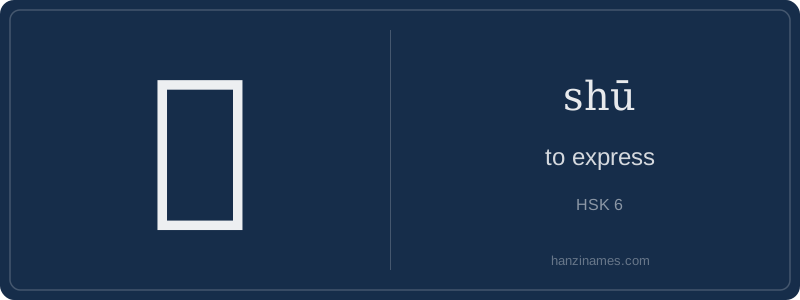
In daily life, 抒 appears almost exclusively in written or formal spoken contexts: essays, literary criticism, music reviews, and HSK-6-level exams. It’s central to the phrase 抒情诗 (shūqíng shī, 'lyric poem') — a canonical genre taught in Chinese middle schools. The idiom 抒发胸臆 (shūfā xiōngyì, 'to pour out one’s innermost thoughts') appears in official media quoting scholars and artists. Historically, it was used by Tang poets like Li Bai to describe poetic self-expression, documented in Song-era commentaries on classical verse.
The character 抒 does not originate from oracle bone script; its earliest attested form is in seal script (c. 3rd century BCE), where it already combines 扌 and 予. While 予 may have pictographic roots (a hand offering something), 抒 itself is a later phono-semantic compound — no verified pictorial origin exists. Today, Chinese students encounter it first when analyzing poetry or writing reflective compositions.
As a linguistic detective, I begin with the character’s anatomy: 抒 is a left-right compound — the radical 扌 (hand) on the left signals physical or intentional action, while the right component 予 (yǔ) originally meant ‘to give’ in ancient texts. This structural clue suggests early connotations of *giving forth* — not just words, but emotion, thought, or intent. The hand radical implies agency: expression here is deliberate, embodied, and active — not passive reception.
Historically, 抒 appears in classical texts like the *Zuo Zhuan* and Han dynasty poetry, always paired with abstract nouns: 抒情 (shūqíng, 'express emotion'), 抒怀 (shūhuái, 'voice one’s aspirations'). Unlike generic verbs for speaking (如说, shuō), 抒 carries literary weight — it’s reserved for conscious, often artistic, articulation. Its consistent use across two millennia confirms its semantic stability: to externalize inner states with purpose.
Crucially, 抒 never stands alone in modern Mandarin — it only appears in disyllabic compounds. This reflects a broader morphological rule: many classical monosyllabic verbs evolved into bound forms requiring pairing. Its absence in spoken colloquialisms (e.g., no one says *‘I 抒 my feelings’*) underscores its formal register. As such, 抒 functions less as a verb you *use* and more as a semantic building block — a precise, elevated tool for naming the act of emotional or intellectual articulation.
Example Sentences
Common Compounds
Similar Characters — Don't Mix These Up
Your First Step into Chinese Culture: Get a Chinese Name
Every journey into Chinese begins with a name. Use our free Chinese name generator to create a meaningful, personalized Chinese name that fits you perfectly.
Get My Chinese Name →