拌
Character Story & Explanation
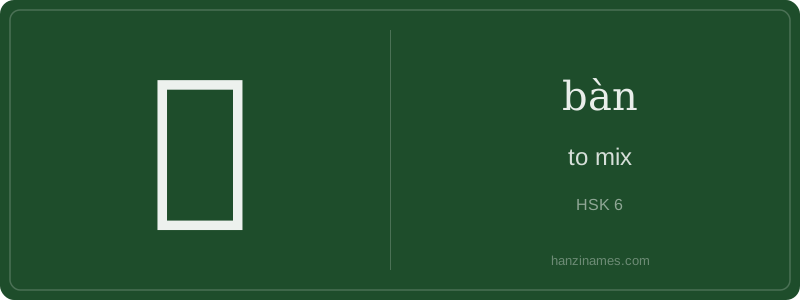
In daily life, 拌 is indispensable in Chinese cuisine—especially cold dishes. The iconic 拌面 (bàn miàn, 'mixed noodles') and 凉拌黄瓜 (liáng bàn huángguā, 'cold-mixed cucumber') appear on menus across China and diaspora communities. It's also used in construction ('mix concrete': 拌水泥, bàn shuǐní) and pharmaceutical contexts (e.g., compounding ointments). Historically, the *Compendium of Materia Medica* (Bencao Gangmu, 1596) uses 拌 to describe mixing herbs with honey or wine for preservation and efficacy.
The character is not pictographic—it evolved from seal script where 扌 (hand) + 半 (half/sound) formed a semantic-phonetic compound. No oracle bone inscriptions contain 拌; earliest attestation is in Han dynasty bamboo slips (2nd c. BCE), consistently meaning 'to mix by hand'. Today, you’ll see it on street-food signs, cooking videos, and factory labels—always signaling active, tactile combination.
Our detective begins at the crime scene: the character 拌. At first glance, it’s a hand (扌) gripping something—but what? The right side, 半 (bàn), means 'half' and doubles as a phonetic clue. This is no accident: in ancient Chinese script, mixing often involved dividing ingredients—like halving herbs or splitting grains before combining them. The hand radical signals agency: someone actively manipulating substances, not just passive blending. Early seal script (c. 3rd century BCE) already shows this structure, confirming its functional design—not pictographic whimsy, but pragmatic orthography.
The ‘half’ component isn’t merely sound-based; it subtly encodes process. To mix thoroughly, one must balance proportions—often starting from halves or equal parts. Think of traditional apothecary practices where herbal formulas required precise halving and recombining. Linguistic evidence supports this: in Middle Chinese (Tang dynasty), 拌 was documented in medical texts like the *Qian Jin Yao Fang* for preparing medicinal pastes—always involving measured division followed by vigorous manual mixing. The character thus embeds both action and proportionality.
Modern usage retains this duality: 拌 implies intentional, hands-on mixing—not automatic or incidental blending. Unlike 混 (hùn, 'to mix randomly'), 拌 demands volition and physical contact. Its eight strokes are economical yet expressive: three for the hand (stroke order: horizontal, vertical, lift), five for 半—each stroke reinforcing control and precision. Even today, calligraphers emphasize the firm downward stroke of 扌 and the balanced symmetry of 半, mirroring the act it describes: deliberate, grounded, and proportionally aware.
Example Sentences
Common Compounds
Similar Characters — Don't Mix These Up
Your First Step into Chinese Culture: Get a Chinese Name
Every journey into Chinese begins with a name. Use our free Chinese name generator to create a meaningful, personalized Chinese name that fits you perfectly.
Get My Chinese Name →