拓
Character Story & Explanation
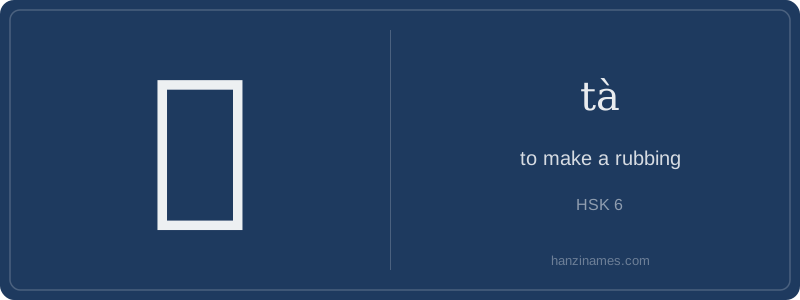
In practice, 拓 (tà) is most commonly encountered in museums, epigraphy workshops, and academic archaeology. Since the Han dynasty, scholars have used ink-rubbing techniques to preserve inscriptions on bronze vessels and stone steles—critical for textual reconstruction when originals erode or are lost. Today, the National Museum of China and Shaanxi History Museum regularly offer public rubbing workshops, and the term appears in official documents like the ‘China Cultural Relics Protection Law’ regarding documentation methods.
The character’s form is not pictographic but phono-semantic: left radical 扌 (hand-action) + right phonetic component 石 (shí, ‘stone’), which also hints at meaning—rubbing requires pressing paper onto stone surfaces. Though 石 here primarily serves pronunciation (tà shares historical phonetic links with shí in Old Chinese), its semantic resonance is unmistakable in actual usage.
At first glance, 拓 (tà) appears technical—a verb for 'making a rubbing'—but it opens a profound cultural portal into how Chinese civilization venerates continuity and resonance across time. Unlike Western notions of originality as rupture, Chinese tradition sees authenticity in faithful transmission: the inked impression of an ancient stele isn’t a copy—it’s a living echo, carrying the calligrapher’s breath and the stone’s weathered grain. This act bridges past and present not through replication, but through tactile communion.
The character’s radical 扌 (hand) underscores embodiment: knowledge isn’t abstract—it’s held, pressed, felt. The right side 石 (stone) anchors it materially, reminding us that wisdom must be grounded—not in theory alone, but in enduring substance. To ‘拓’ is to participate in a lineage where history isn’t archived; it’s re-performed, hand-to-stone, with reverence and precision.
This worldview reveals a deeper truth: preservation is not passive conservation, but active engagement. Every rubbing is both homage and interpretation—slight pressure variations yield distinct textures, just as each generation reads ancient texts anew. Thus, 拓 embodies a dynamic harmony: fidelity without fossilization, innovation rooted in reverence. It reflects the Confucian ideal of ‘continuing the Way’—not by rigid repetition, but by breathing life into inherited forms with integrity and care.
Example Sentences
Common Compounds
Similar Characters — Don't Mix These Up
Your First Step into Chinese Culture: Get a Chinese Name
Every journey into Chinese begins with a name. Use our free Chinese name generator to create a meaningful, personalized Chinese name that fits you perfectly.
Get My Chinese Name →