拔
Character Story & Explanation
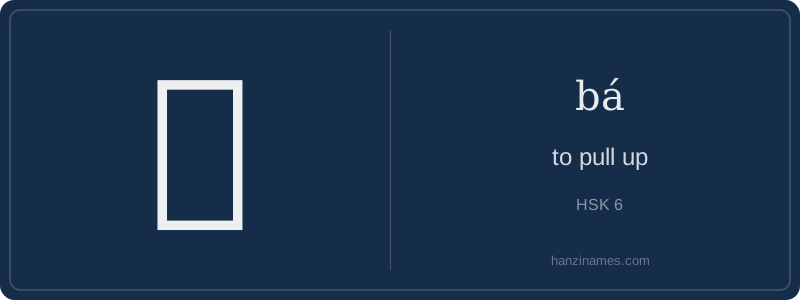
In daily life, 拔 is ubiquitous: Beijing subway commuters say 拔电话 (bá diànhuà) for 'make a phone call' (literally 'pull a phone call' — from the era of rotary phones where dialing involved physically pulling a rotating disc). It appears in HSK 6 vocabulary like 拔尖 (bá jiān, 'top-tier') and official terms like 拔冗 (bá rǒng, 'spare time from busy schedule'). The idiom 拔地而起 (bá dì ér qǐ, 'rise abruptly from the ground') vividly describes China’s rapid urban construction — documented in State Council reports since the 2000s.
The character is not pictographic; its form evolved from seal script where the right component 犮 (bá) represented ‘removal by force’, combined with 扌 (hand). No oracle bone inscription survives for 拔 — it first appears reliably in Warring States bamboo texts as a verb meaning ‘to extract’ or ‘to remove’.
Imagine a farmer in rural Sichuan crouching in damp spring soil, gripping the base of a stubborn weed—its roots deep and tangled. With steady force, he pulls upward, muscles straining, until the plant comes free with a soft *shuck*. That decisive, vertical extraction is the essence of 拔 (bá): not just lifting, but uprooting with purpose and effort. It conveys agency, resistance overcome, and irreversible removal—whether physical, metaphorical, or institutional.
The character’s hand radical (扌) signals bodily action, while the right side (犮) historically suggested ‘to extract’ or ‘to remove decisively’. In modern usage, 拔 extends far beyond agriculture: it appears in military commands (拔营 — 'strike camp'), tech jargon (拔网线 — 'pull the Ethernet cable'), and even slang like 拔草 ('pull grass', meaning to cancel an intention after researching a product). Its energy is active, final, and often urgent.
Unlike passive verbs like 取 (qǔ, 'to take') or 拿 (ná, 'to hold'), 拔 implies overcoming resistance—roots, attachments, or inertia. This makes it vital in idioms like 拔苗助长 (bá miáo zhù zhǎng, 'pulling up seedlings to help them grow' — i.e., counterproductive haste) and 拔刀相助 (bá dāo xiāng zhù, 'draw one’s sword to aid another' — heroic intervention). Mastery of 拔 unlocks nuanced expression of willpower, disruption, and liberation in Chinese.
Example Sentences
Common Compounds
Similar Characters — Don't Mix These Up
Your First Step into Chinese Culture: Get a Chinese Name
Every journey into Chinese begins with a name. Use our free Chinese name generator to create a meaningful, personalized Chinese name that fits you perfectly.
Get My Chinese Name →