拙
Character Story & Explanation
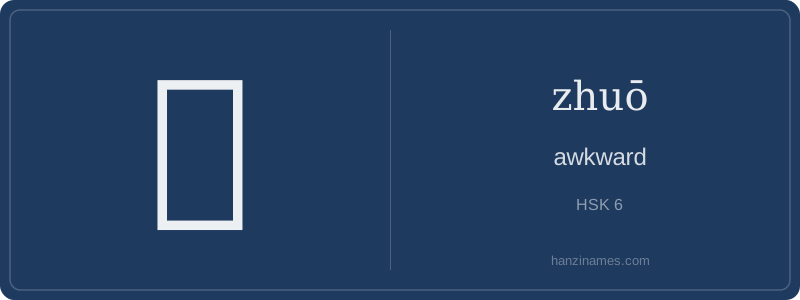
拙 is most famously used in the humble self-reference phrase 拙作 (zhuōzuò), meaning 'my clumsy work', commonly seen in prefaces to books, art exhibitions, or academic papers — still widely used by Chinese authors and artists today. It also appears in the idiom 大巧若拙 (dà qiǎo ruò zhuō): 'Great skill appears clumsy', a Daoist concept from the *Dao De Jing* (Chapter 45), emphasizing that true mastery is unshowy and natural.
The character’s modern form (8 strokes, radical 扌) developed from seal script; its right component is not the modern 出 but a simplified variant of a phonetic element once pronounced similarly to zhuō. No pictographic origin exists — it’s a phono-semantic compound. Today, Chinese people use 拙 mainly in formal writing, calligraphy seals, or literary speech — never in casual texting or slang.
Hi students! Let’s explore 拙 (zhuō), a character that means 'awkward', 'clumsy', or 'unskilled' — but with a very special cultural twist. Unlike English words like 'stupid' or 'inept', 拙 carries humility and sincerity. In classical Chinese, scholars often used 拙 to modestly refer to their own work — like calling a poem 'my clumsy verse' — not as self-criticism, but as polite self-deprecation. This reflects the Confucian value of modesty over boastfulness.
Don’t confuse 拙 with simply 'bad'. It’s never harsh or insulting. You’ll rarely hear someone say 'He’s 拙 at cooking' to criticize — instead, it appears in formal, literary, or self-referential contexts: book prefaces, calligraphy inscriptions, or poetic lines. Its tone is gentle, respectful, and deeply traditional — making it more common in written than spoken Mandarin.
The character combines 扌 (hand radical) and 出 (chū, 'to go out'), but don’t read this literally. Historically, the right side evolved from an older form meaning 'not smooth' or 'blocked', reinforcing the idea of difficulty or lack of fluency. As you learn HSK 6 vocabulary, remember: 拙 isn’t about failure — it’s about grace in humility, and wisdom in restraint.
Example Sentences
Common Compounds
Similar Characters — Don't Mix These Up
Your First Step into Chinese Culture: Get a Chinese Name
Every journey into Chinese begins with a name. Use our free Chinese name generator to create a meaningful, personalized Chinese name that fits you perfectly.
Get My Chinese Name →