搓
Character Story & Explanation
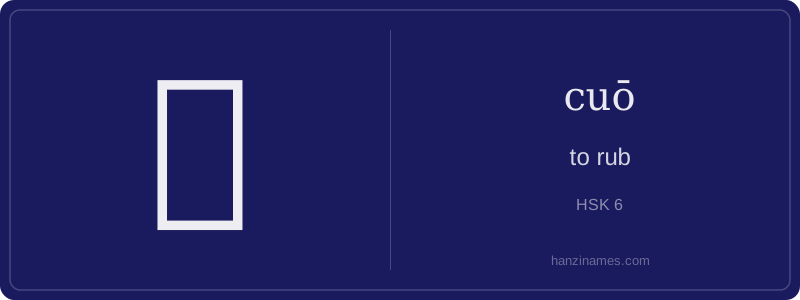
In modern China, 搓 is indispensable in daily hygiene (e.g., 搓澡—‘body scrubbing’), traditional medicine (e.g., 搓药丸—rolling herbal pills), and even culinary prep (e.g., 搓面—kneading dough). It appears in the common phrase 搓手 (cuō shǒu)—literally ‘rub hands’, used idiomatically to express eager anticipation or nervousness, documented as early as the Qing dynasty in vernacular fiction like Officialdom Unmasked.
The character is a semantic-phonetic compound: 扌 (hand radical) denotes action involving hands; the right component 叚 (jiǎ, archaic variant of 假) serves primarily as a phonetic cue for cuō—though its original meaning ‘to borrow’ is unrelated. No oracle-bone or bronze script form survives; the earliest attested form appears in Han dynasty clerical script, already bearing its modern structure and meaning.
As an archaeologist brushing dust from a Tang-dynasty medical manuscript, I found 搓 etched beside illustrations of therapeutic hand techniques—its 扌 radical unmistakably signaling manual action, while the 叚 component, though phonetic, echoes ancient terms for 'pressing' and 'kneading'. This isn’t mere rubbing; it’s intentional, rhythmic friction—rooted in empirical bodily knowledge long before modern physiology.
Excavating Song-era folk texts revealed 搓 embedded in daily hygiene rituals: villagers ‘搓澡’ (cuō zǎo) to exfoliate with loofahs and coarse towels—a practice so widespread that bathhouse murals from Kaifeng depict multi-generational families performing it together. The character’s 12 strokes map a physical sequence: grasp, press, twist, roll—each stroke a deliberate motion preserved in ink.
Even Ming pharmacopeias cite 搓 in herbal preparation: practitioners ‘搓丸’ (cuō wán) to roll medicinal pastes into pills by hand, ensuring uniform density and dosage. Unlike mechanical grinding, this method preserved volatile compounds—proving 搓 was not just linguistic shorthand but a codified biomechanical technique refined over centuries of empirical observation.
Example Sentences
Common Compounds
Similar Characters — Don't Mix These Up
Your First Step into Chinese Culture: Get a Chinese Name
Every journey into Chinese begins with a name. Use our free Chinese name generator to create a meaningful, personalized Chinese name that fits you perfectly.
Get My Chinese Name →