掷
Character Story & Explanation
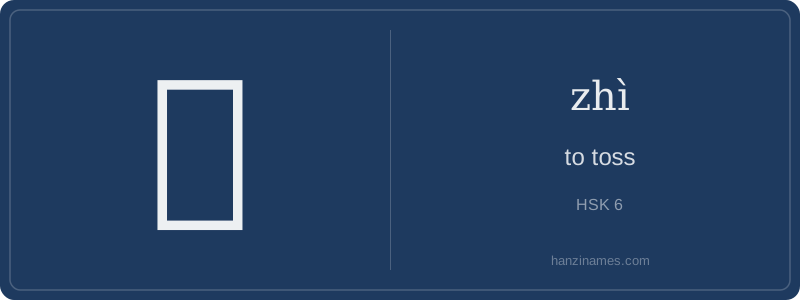
In contemporary Chinese, 掷 appears most frequently in formal or literary contexts—not daily chit-chat. It's standard in sports reporting ('掷铁饼', discus throw), legal language ('掷弹' for grenade throwing), and idioms like '孤注一掷' (to stake everything on one throw), a phrase documented since the Song dynasty and still used in finance and politics to describe high-risk gambles.
The character’s form is not pictographic but phono-semantic: 扌 (hand) signals meaning; 郑 (zhèng, now obsolete as a standalone character) originally provided sound. By the late Warring States period, variants with 隹 or 耳 appeared, but the modern shape stabilized in the Kangxi Dictionary (1716). Today, Chinese learners encounter it first in HSK 6 vocabulary lists tied to abstract risk-taking—not playground games.
As an archaeologist brushing dust from a Han dynasty bamboo slip, I uncovered 掷 not as a static glyph—but as a kinetic fossil of human motion. Its 扌 (hand) radical anchors it in embodied action, while the 口 + 十 + 丶 structure—later standardized as 郑—evolved into today’s 掷. Early clerical script fragments show it paired with objects like dice and spears, revealing its core function: deliberate, forceful projection by hand.
This character survived dynastic shifts not as ritual incantation but as practical notation: military manuals recorded '掷矛' (to hurl spears), and Tang poets used it for emotional release—'掷笔长叹' (tossing down the brush in despair). Unlike abstract philosophical terms, 掷 was etched onto everyday tools and tax records, proving its lexical durability came from utility, not ideology.
Crucially, 掷 never meant gentle placement—it implies intent, momentum, and consequence. In Ming legal documents, '掷石伤人' (tossing stones that injure) carried strict liability, confirming that even 600 years ago, the character encoded causality: hand action → object trajectory → real-world impact. That semantic precision is why it endures in modern Mandarin as the definitive verb for purposeful tossing.
Example Sentences
Common Compounds
Similar Characters — Don't Mix These Up
Your First Step into Chinese Culture: Get a Chinese Name
Every journey into Chinese begins with a name. Use our free Chinese name generator to create a meaningful, personalized Chinese name that fits you perfectly.
Get My Chinese Name →